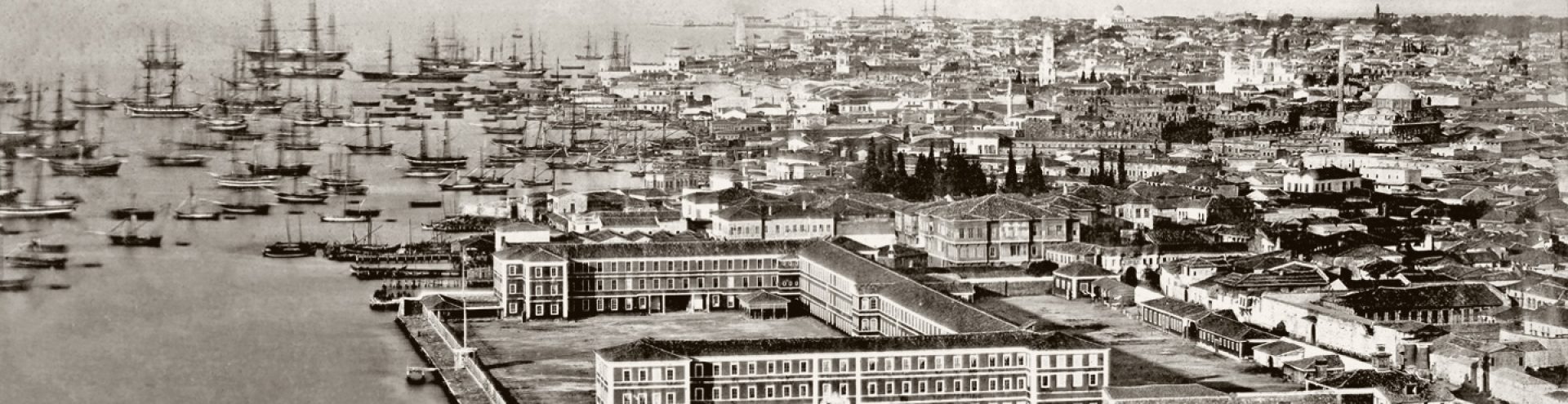
For nearly two centuries after it came under Ottoman rule, Izmir was a small coastal town and an agricultural region, mainly producing produce for the sustenance of Istanbul. From the late 16th century onwards, the changing trade routes, especially due to the Ottoman-Iranian war, transformed İzmir into a center for trade between east and west, paving the way for the birth of the city that would be called the Capital of the Levant.

17. century, the construction of the Sancak Castle due to the increasing importance of the port, the 1688 earthquake that caused great destruction in the city, the influx of merchants of all European nations to İzmir in parallel with the growth in trade volume, and the subsequent opening of foreign missions in İzmir by each of these states, The transformation of İzmir and its surrounding area into a raw material supply depot for the developing European industry with industrialization and the realization of many public and private infrastructure investments such as the new port, customs building, railway, inns, etc., is a brief summary of the period.
As a result of developments that spanned three centuries and accelerated mainly in the 19th century, İzmir became one of the largest cities in the Eastern Mediterranean in the early 20th century, with a central population of over 200,000 and a total population of over 500,000, and as the second largest foreign trade port of the Empire after Istanbul.

Necmi Ülker, The Birth of İzmir as a Commercial Port (1688-1740),
Izmir Development Agency Culture Publications
Click here to access the publication.
The British merchants who received the concession established the İzmir Dock Company and contracted with the French firm of the Dussaud brothers, who had previously built the Port of Marseille, for the construction. While the construction of the dock was underway, the concession changed hands and the firm of the Dussaud brothers took over the concession in 1869.
The construction of the docks covering the area from Sarı Kışla (today Konak Square) to Tuzlaburnu (today Alsancak Port) was largely completed in 1876 and in a very short period of time, a great increase in efficiency in loading and unloading operations was achieved.
With the construction of the docks, Izmir gained a modern port infrastructure, and the coastline that gives the city its identity today, which we call Kordon, emerged. The Customs House (now Konak Pier) and the Pasaport breakwater along this coastline are important cultural heritage that carry the memory of the city.


Necmi Ülker, The Birth of İzmir as a Commercial Port (1688-1740),
Izmir Development Agency Culture Publications
Click here to access the publication.
The greatest danger for a port-city is that the silt carried by a nearby river will fill the sea and the port will become unusable over time. Throughout history, many port-cities lost their harbors for this reason and disappeared from the stage of history. The reason why the ancient cities of Ephesus and Pergamon, which are located within the borders of our province, disappeared from the stage of history is that the alluvial deposits filled the sea and rendered the harbor dysfunctional by severing the connection between the city and the sea. In modern times, Izmir faced a similar danger. By the second half of the 19th century, the alluvial deposits of the Gediz River and occasional flooding had reached a level that affected the access of ships to İzmir Port. An examination of the sources of the period reveals that local public officials and representatives of foreign states prepared numerous reports drawing attention to the danger.
It was decided to change the bed of the Gediz River in order to eliminate this danger, which had the potential to produce consequences that would deeply affect Izmir-based trade, such as the transformation of the Gulf of Izmir into a small lake and the disappearance of the port. In this context, the works that started in 1885 were completed in 1886 and the bed of the Gediz River was changed to allow it to flow further north. Thus, considering the examples in history, it would not be an exaggeration to say that the port of Izmir was saved, and accordingly, Izmir was saved.