Evliyâ Çelebi was undoubtedly the greatest Ottoman traveler of the 17th century. He traveled the Ottoman lands (Balkans, Anatolia, Western Asia, Middle East, Egypt) and neighboring countries for more than fifty years and collected what he saw and experienced while the empire was at its cultural peak in his famous 10-volume work Seyahatnâme. Evliya Çelebi has been widely read in many languages for more than three centuries and his Seyahatnâme is a treasure trove for the history of the cities and geographies he visited.
Evliyâ Çelebi arrived in İzmir in 1671 following the route of Bergama, Menemen, Foça and visited the city; after visiting Urla, Karaburun, Çeşme, Sığacık, Seferihisar, Selçuk, Tire, Bayındır and Birgi, he continued his journey towards Aydın. In his Seyahatnâme, he provided detailed and colorful information about the historical, geographical and cultural situation of İzmir and its surroundings.
Çelebi's first stop was the place known today as Halkapınar. At that time, this place was a promenade for the people of Izmir with its beautiful spring, which was the subject of legends with its talismanic fish, its grassy area, its shady and fresh air. When Çelebi came to ‘Halkalı Bınar', the dignitaries of Izmir, who were feasting here, welcomed Çelebi to the assembly; our traveler met many of his old friends in this assembly; he chatted with them, had fun and rested.
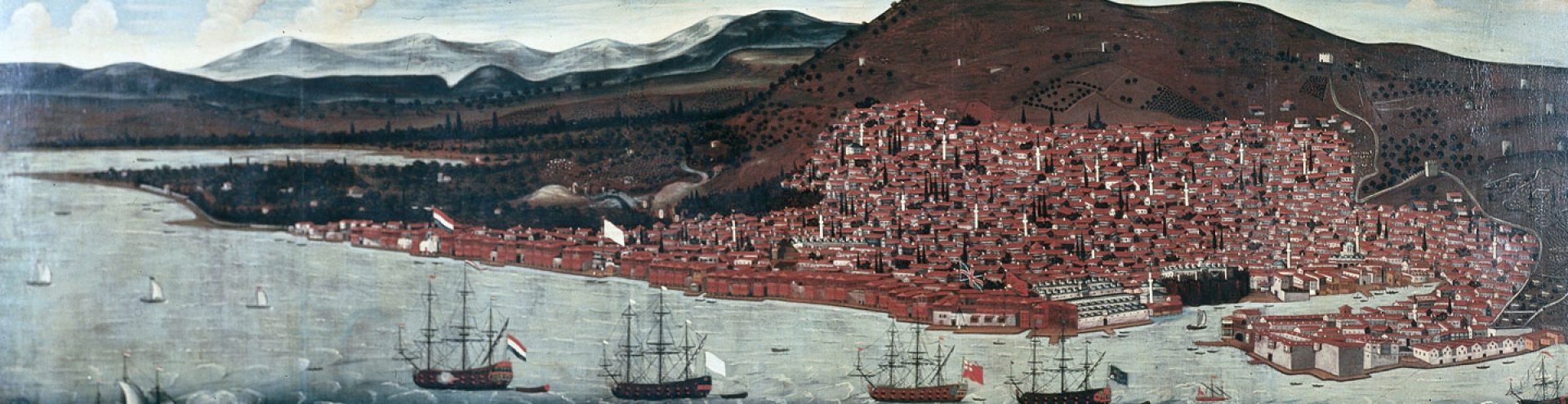
There is no record in the Seyahatnâme about how long Çelebi stayed in the center of İzmir. We also do not find any information on the order in which he visited the city and its sights. Çelebi describes the buildings such as castles, mosques, inns, baths, almshouses, lodges, tekkes and tombs in the places he visited, not in the order in which he visited them, but by classifying them according to their types. What we want to focus on here is his description of the Izmir Harbor Castle. Since the castle no longer exists and there are no documents such as detailed paintings or photographs, Çelebi's account provides important information about this defensive structure.
Çelebi writes, “This castle has a quartermaster and 80 nephers. Its jabehan is very well-equipped.” Çelebi mentions the number of commanders and soldiers in the castle. He also mentions a castle inscription that no longer exists: “On a white marble above the castle gate, the date is written in celi calligraphy as follows: “Alhamdü lillâhi Rabbi'l-âlamin, wa's-salâtu wa's-salâmu alâ Muhammadini'l-ma'sûmı'Tkevneyn, emmâ mu'ebbede's-sultan-i zaman, Fâtihu es-Sultan nâm Mehemmed bin Murâd Khan min nesli âli Osman, li-sene ihdâ wa [seb'în?] ve semân mie. [871?]”
This inscription quoted by Çelebi states that the harbor fortress was built by Sultan Mehmet the Conqueror himself. Historical records also support this information. In 1472, years after the partial destruction of an older castle originally located in the same place by Timur's army in 1402, Mehmet II ordered the castle to be rebuilt in 1479 for the defense of the city after the Venetian admiral Pietro Mocenigo had easily hit Izmir from the sea with his ships and plundered the city with his troops. The new harbor fortress, planned as a three-cornered structure, was built on the existing foundations. Evliyâ Çelebi visited this new castle in the summer of 1671, about 190 years after it was built, and described it in the following words:
“It is a beautiful castle, a stone structure with four corners on a low flat place on the seashore. It was built by Sultan Mehmed the Conqueror on (-). Its circumference is 1,280 feet. However, the land side is a wide and deep moat that comes up to 3 steps, and the other sides are the castle wall that beats the sea. All of them are magnificent cannons protecting the harbor. It has solid and durable gates with 2 storey iron wings facing the qibla. There is 1 masjid and 20 households inside the castle, other than that there is no trace of an almshouse. However, on the inner side of the castle gate, there is a well of icy water. It is a strange wisdom that this castle is in the sea and has such abundant water, it is a sight to behold.”

The Izmir Port Castle was actually a three-cornered defense structure and was important for the protection of the city against threats from the sea. Apparently, at the time of Çelebi's visit, in addition to its sea-facing facades, there was a moat on its landward border. The castle gates facing southeast probably opened towards the square in front of the Hisar Mosque. In fact, the name of the Hisar Mosque came from the Hisar located there.
It is indeed surprising that a castle built by the sea should have a drinking water source like the one described by Evliyâ Çelebi.