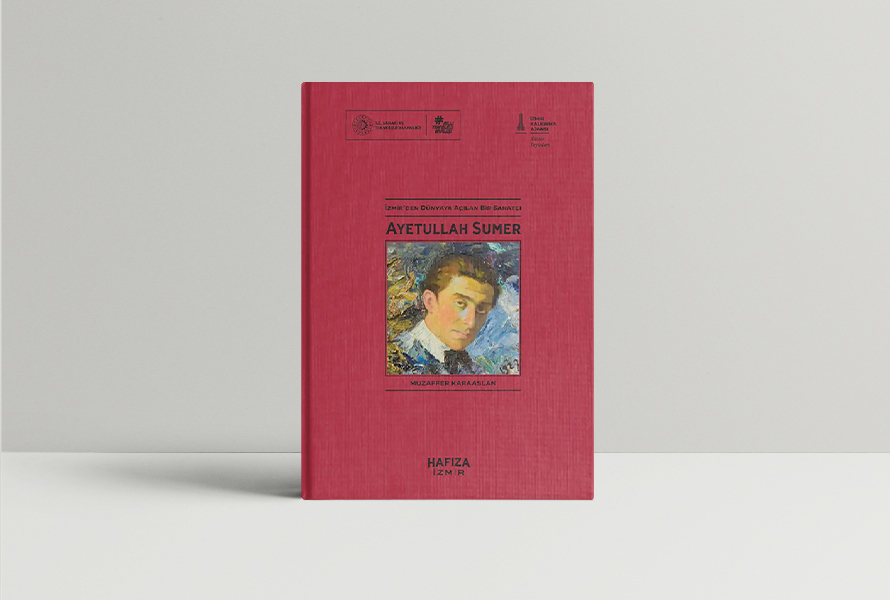
Ayetullah Sumer, one of the leading names of Turkish painting, was born in Izmir in 1905. He started his artistic career in Izmir and continued in Marseille, Paris and Istanbul. Sumer, who grew up under the influence of the changing education system and understanding of art in the last period of the Ottoman Empire, became one of the pioneers of new ideals with the proclamation of the Republic. The artist, who witnessed the War of Independence and the birth of the Republic due to his age, especially felt the days of the occupation of Izmir deeply. The struggle for liberation, Atatürk's arrival in Izmir and the great transformation of the city were among the important elements that inspired his art.


Sumer was sent to Marseille in 1925 to study commerce. However, in addition to his commercial education, he also attended the workshop of Theophile Berengier, one of the teachers of the Marseille Academy of Fine Arts, part-time, further strengthening his interest in painting. Returning to Turkey in 1927 after completing his commercial education, the artist was again sent to France with a state scholarship in 1928 upon the recognition of his talent and began to study painting. Sumer won the exam at the Paris Academy of Fine Arts, where he became a student of Paul Baudoüin, the head of the Fresco Workshop.
Ayetullah Sumer held many solo exhibitions and participated in group exhibitions in France. The silver medal he won for his painting ’Woman in Black“ at the Versailles Salon Exhibition in 1932 is very important both for his career and for Turkish painting.
Sumer returned to Turkey after completing his studies in France and became prominent both as an instructor at the Academy of Fine Arts and as a painter. In particular, his establishment of the Fresco Workshop contributed greatly to the academic development of the art of mural painting in Republican-era Turkey. While producing murals on the one hand, he was also one of the names that shaped art by training new artists on the other.
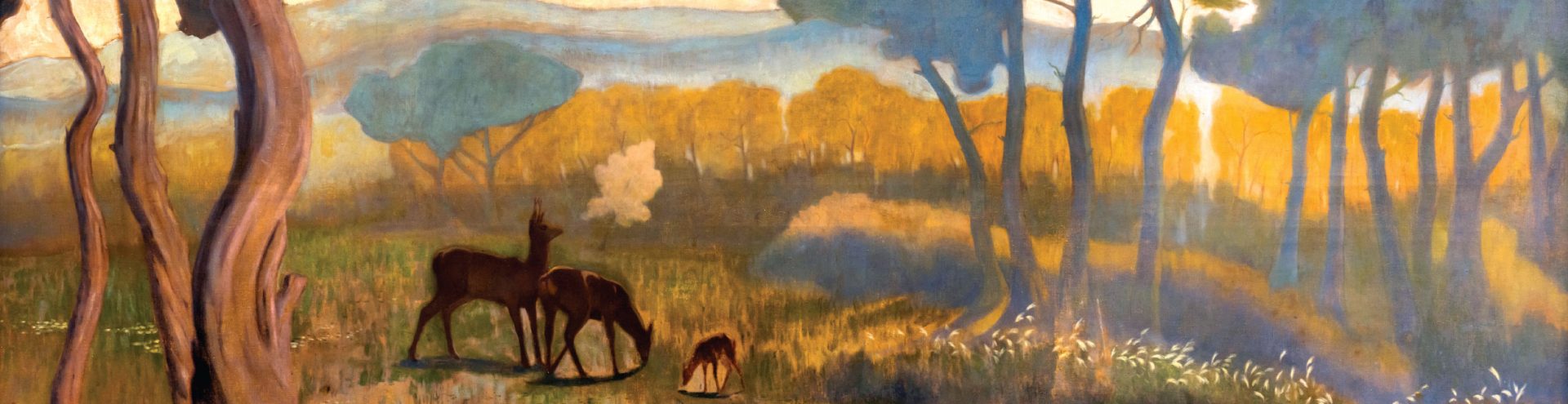
The artist's landscapes, still life and portrait works attracted great attention in the art world, and the intense demands from official institutions and private collections clearly demonstrated this interest. Sumer's artistic life can be divided into three periods. However, the artist's openness to experimentation and constant change make it difficult to categorize his works into periods. This is because there are natural and fluid transitions between periods rather than sharp distinctions. While these transitions bear the traces of his artistic quest, each period laid the foundation for the next. We can observe the differences between periods most clearly in his landscape paintings. In his first period (İzmir-1939), the influence of impressionism is evident. In the second period (1940-1950), he adopted an eclectic approach between impressionism and realism, and this period was a transitional phase. The third period can be defined as the maturity phase; in this period, the artist approached his works with a more realistic understanding. The artistic changes he experienced over the years are a reflection of the artistic environment and his intellectual world. Especially during his education in France, his teacher Paul Baudoüin at the Paris Academy of Fine Arts was an impressionist, which directly influenced the artist's early works.


During the transition period between 1940 and 1950, the debates between modern art and academic art made their impact felt at the Academy. During this period, Sumer intellectually defended classical painting education and this approach was reflected in his works. Although traces of impressionism can still be seen, the artist gradually began to turn towards realism. During his maturity period between 1950 and 1979, the realist approach became fully evident and the artist received the most commissions. In addition to official institutions, the educated and wealthy families of Istanbul showed great interest in Sumer's works. Although landscape paintings play an important role in private commissions, his portrait works are of particular importance.

Portraiture is one of the most important themes of Sumer. Defining himself as a portrait painter, the artist believed that in order to be a good portraitist, one must also be competent in landscape and still life art. Sumer worked on portraits even during his years in Izmir, where he had no art education, and his success in this field was rewarded with a silver medal for his painting ’Woman in Black“ at the Versailles Salon Exhibition in 1932. In Turkey, İsmet İnönü invited him to paint his portrait, which once again proved the artist's mastery in this field.
The importance Ayatollah Sumer attached to the art of portraiture is clearly understood from the works he produced throughout his life. The fact that he painted portraits of statesmen such as Mustafa Kemal Atatürk and İsmet İnönü, as well as soldiers, artists and historical figures, is one of the most important indicators emphasizing the place of portrait art in his artistic life.


The artist's understanding of portraiture reached an earlier maturity compared to his landscape paintings. Although the effects of impressionism are evident in his early portraits, it is noticeable that he tended towards realism even before entering the transition phase. The same tendency is also evident in his still life works.
One of the elements that make Ayetullah Sumer important in the history of Turkish art is his active role and contributions to the Fine Arts Union. The Fine Arts Union, which has an important position in the art scene of Turkey, is a remarkable organization with its deep-rooted history and the exhibitions it organizes. Sumer, who joined this tradition from the Ottoman Society of Painters in 1934, was elected to the board of directors in 1937 and assumed various duties until 1955. The artist remained an active member of the association until his death, participating in exhibitions organized in Istanbul, Ankara and other cities in Anatolia, and curating some of them.
Ayatollah Sumer's identity as an artist was not limited to his works and teaching. As mentioned before, he has curated many exhibitions and written various articles on art. He took part in many organizations that contributed to the development of Turkish art and carried his art to exhibitions not only in Turkey but also in different cities in Europe.
Sumer showed a deep commitment to art and his house also functioned as a workshop. When he built his apartment building Villa Sumer in Şişli in 1949, he reserved a special place for workshops. In this apartment, he and his wife Semiha Hanım opened the Painting and Oil Painting Course and trained many students. The couple's joint work was not limited to this, and some of the murals painted for many official institutions were projects they prepared together. The Sumer couple's house became an important center in the art scene of the period; it became a cultural meeting point with various invitations, long art talks and exhibitions.

Ayatollah Sumer is a painter who has accomplished a great deal in his seventy-four years of life. Today, his works are in collections in different corners of the world, proving that he is an artist beyond borders. Sumer spent his childhood and youth in challenging years, but developed as an artist raised in the idealistic spirit of the Republic. This idealistic approach made him an artist who came out of Izmir and opened up to the world.