In ancient times, our people have always kept their distance from the sea. They avoided direct contact with it and satisfied their thirst for water from streams, creeks and hot springs. Of course, it is surprising to be so close to the sea and yet so far away from it. Is it the huge waves of the sea or the salty water that causes this? Maybe it was both. And what is tanning like now? In the old days, white skin was acceptable.
Once upon a time, people did not revel in the water of the sea, but in its vast blueness and air. Then, in the 1700s, according to the rumor, at that time ’sea water is very healing, like hot spring water, it is a cure for many problems” spread from tongue to tongue. In that era when the rabies vaccine had not been discovered, it was openly written in encyclopedias, dictionaries and all medical books that the most effective way to treat a person bitten by a rabid dog was to take a sea bath. The physicians of the time wrote page after page of treatises and brochures praising sea bathing. Of course, man is a mortal being, he is afraid of death. He realized that the sea was an endless source of healing; he immediately jumped into the sea water. But not for swimming; for bathing! That's why we call it “sea bathing”. It will be closed on all four sides. It will not be too deep. You can never see inside from the outside. But the top will be open. And it will be separate for men and women. If they are close, they will never be heard from each other. It should be called the “sea bath” so that the residents of the neighborhood can add a new one to their bathing rituals.
Although sea baths are often associated with the Bosphorus, Golden Horn, Kumkapı and Salacak beaches, their counterparts in Izmir are just as intriguing. After all, if Istanbul has its Pera, beautiful Izmir has its Frenk Quarter. Moreover, it is a port city and therefore a Levantine hotbed. This group, who were Frankish ayans, valued the sea very much. In front of their mansions, they would build sea baths in the form of small ornate rooms. When the Muslim and non-Muslim people heard that they went to the sea every day, they would make their way to the sea baths, partly out of amazement and partly out of curiosity. This is how the precious former inhabitants of our beautiful Izmir got used to the sea... First, they went to the sea baths for healing, and then they started to go to the sea baths for a holiday. In time, the interior of the baths became too narrow, and they started to remove the wooden curtains and take a stroll into the endless sea. Sunbathing on dry wood no longer gave them pleasure, so they immediately threw themselves on the warm beaches. Then they followed the French fashion and the word "beach" became a household word.

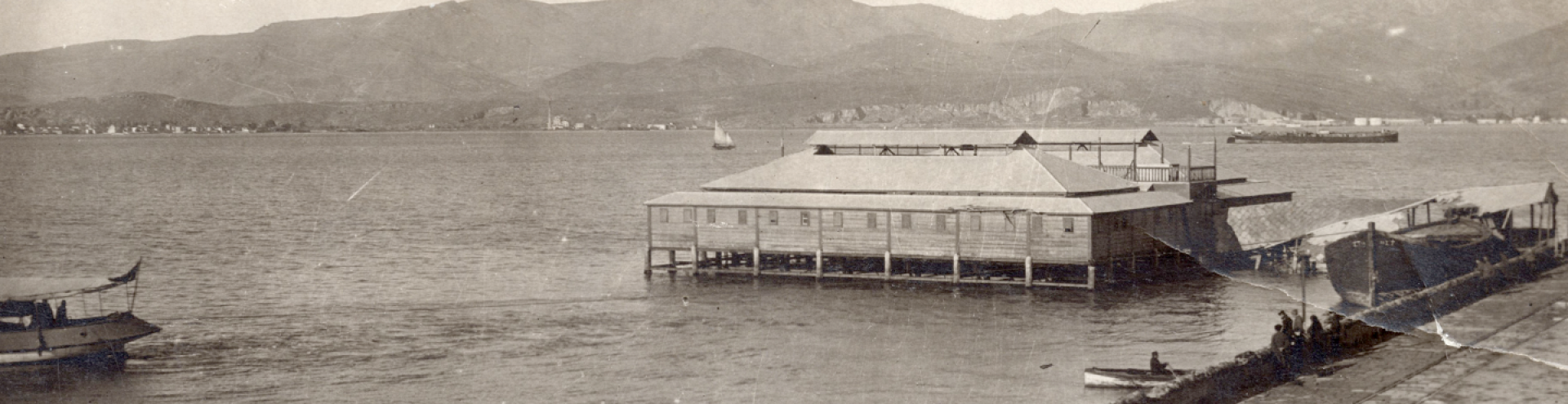
It is difficult to know how long sea baths have existed in Izmir. According to official records, Emin Efendi, the Clerk of Foreign Affairs, had a sea bath built in 1829 to provide income for the Gurebâ-ı Müslimin Hospital. Based on this, we can infer that there were sea baths in the city at least in the early 1800s. However, it is difficult to determine the exact number of sea baths in the city. According to the Aydın Vilayeti 1330 Sene-i Maliyesi Ticaret Rehberi, there were 17 sea baths in İzmir in 1914. Some of these baths were not operated during the First World War; the number of sea baths dropped to 12 in 1918 and 1920. The following year, the number dropped even further to 10 sea baths. According to the report prepared by the International American College Research Committee in 1921, there were 11 sea baths in the city on the same date. In the 1918 records, six of the sea baths were run by Muslims, four by Greeks and two by Levantines. In addition, 24 people, including four children, were working in these sea baths.
Sea baths were usually established around Alsancak harbor and in Karşıyaka. Although the sea baths in Alsancak were very popular with the public, it was said that they were not clean. Because the city's wastewater was poured into this area. Also, when the wind blew towards the city, the sea water would become turbid and some of the garbage and garbage would mix with the waves into the pool of the sea baths. But because of their convenience, people used to come to these baths rather than the ones in Karşıyaka. At that time, the beach and water in Karşıyaka were very clean. Perhaps because the baths here were only open two days a week, people flocked to Alsancak. Among the sea baths in Karşıyaka, the one next to the dock was the sea bath belonging to the İzmir Industrial School. Boarding students would come here on their days off and swim. And since it was in a low-lying area, locals would also come here. Therefore, it was a bathhouse with plenty of customers.

Customers flock to sea baths. And our local companies were whetting their appetite. They realized that the locals were very much in demand for these places. So, they opened luxurious sea baths in various, prosperous, and privileged places in Izmir. One of them, the Kasaba Railway Company, even issued a special tram schedule for the customers coming to the sea baths. However, the fate of this bathhouse was more disastrous than expected and it collapsed suddenly, killing several people. Close to this bath, there was another sea bath called Aya Triada, also owned by another company, which catered to the elite of Izmir.
Rich people who did not prefer public sea baths would have private sea baths built in front of their mansions if they had one by the sea. These small, elegant and aesthetic baths would appear as ornate boxes along the shore. These baths were usually found on Göztepe and Karataş coasts. So, which mansions had these sea baths? The list is long, but let us tell you some of them: Şamlı Mansion, also known as Hulusi Nalbantgil Mansion, Kasabalı Nuri Bey Mansion, Ragıp Şamlı Mansion, Nazif Öktem Mansion, son-in-law of Kardıçalı İbrahim Bey, Yemişçi Mansion, also known as Keresteci Sabri Bey Mansion, Nişli Mansion and Governor's Mansion... Except for the Governor's Mansion and Nişli Mansion, the other mansions were located in Göztepe. The Governor's Mansion was located on a route between Sadıkbey and Göztepe.

The private sea bath in front of the Governor's Mansion was a little different from the other mansions. Resembling a small ferry pier, this bathhouse was open on all sides and only had a roof built on poles. It was built to fit 20-30 people comfortably. Curious people passing by the mansion would watch this bathhouse out of the corner of their eyes to see if the governor was swimming or not. Nişli Mansion was located in Karantina. You could enter this bathhouse from the garden of the mansion.

The air of freedom provided by the Republic also changed the characteristics of sea baths. As apartment buildings became visible in the city, sea baths exclusive to apartment buildings emerged. However, the people used to call them baths rather than hammams, following the fashion. The most well-known ones were Üç Deniz Banyosu, or the Banyosu of the Aydınlıs as it was popularly known, and the sea bath of Binnaz Apartment. There was also the bath of the Sapmazs. Young people in Karantina used to benefit a lot from these sea baths. Various games and entertainments were organized in the sea bath of Binnaz Apartment. Relay races, jumping shows and various games were played. But unlike the usual sea baths, the side facing the sea was open. Unlike other sea baths, outsiders could also benefit from these baths.
In a nutshell... These places, which existed for a long time in the daily life of Izmir, no longer exist today. It is doubtful that even older people remember them. But the new generation has never even heard of these baths. Let alone hearing of them, they are not even in their imagination. However, if they knew, the beaches where they run to cool off in summer were inspired by these places. The sea baths, which continued their existence in different forms until the 1970s, are now waiting to be reminisced in the form of lifeless memories in the nostalgic memory of Izmir.