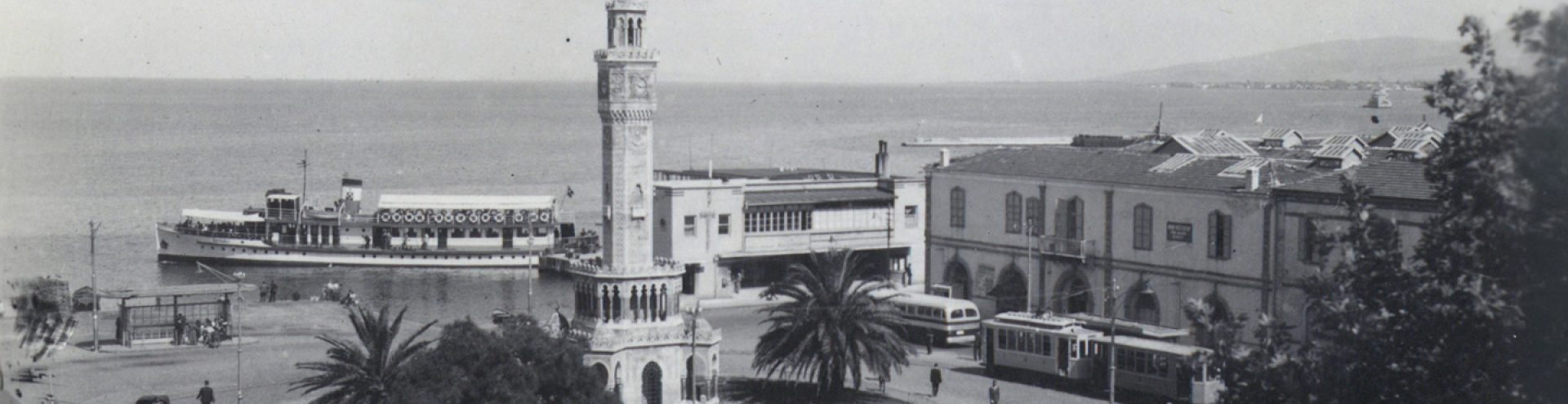
In the heart of Izmir rises an elegant symbol that cannot stop time but carries the past into the present: Clock Tower. This magnificent structure, which harbors the traces of history in every stone and the spirit of the city in every clock wheel, has been the symbol of Izmir for centuries. The pearl of Konak Square is a silent witness of the city's cultural mosaic.
In 1900, as Sultan Abdülhamid II completed his 24th year on the throne and was preparing to enter his 25th year, a National Holiday was declared in the country in honor of this special period. While celebrations were held all over the country, new monuments were started to be built to commemorate the day. Ahenk, one of the newspapers of the period, announced the information about the work planned to be built in Izmir to the public with the following statements:
“This work, which will be brought into existence in our city on the occasion of the twenty-fifth anniversary of the Cülüsun [ascension to the throne], is a very musanna [work of art] fountain with a clock tower visible from four sides, which will be built on a marble-paved ground near the Kışla-yı Hümayun [Yellow Barracks].” (Yetkin, 2016, p.13-14).”

The construction of the tower was meticulously carried out by Raymond Charles Péré, a Levantine of French origin and one of the most important architects of the period. Péré completed this elegant structure, which reflects the cosmopolitan texture and aesthetic sense of the city, in 1901. The tower is 25 meters high and has four floors, resting on an octagonal marble base with four steps. There are fountains on the sides of the pedestal and four clocks on the upper part of the body. Although it is said that the clocks were gifted by the German Emperor Wilhelm II due to the Ottoman-German affinity, this information is not certain. The cut stones and detailed decorations used in the tower reveal the architectural style of the period.
In addition to its architectural design, Izmir Clock Tower has a great importance in the social and cultural context. It has become an important cornerstone of Izmir during the modernization process and continues to exist today as an indispensable part of city life. It has witnessed meetings, joys and sorrows over the years and left a deep mark in the memory of the city. This tower, which is a guest in people's memories and adapts to the rhythm of city life, continues to show itself as a symbol in the heart of Izmir. The Clock Tower, which harbors a story in every corner, stands out as the living memory of today and tomorrow with its commitment to the history and culture of the city.
As Ahmet Hamdi Tanpınar put it, “Time itself is space, its march is time, its setting is man... This shows that time and space exist with man.” Izmir Clock Tower, as a symbol that brings these concepts together, stands at the point where time and space are integrated with human beings.