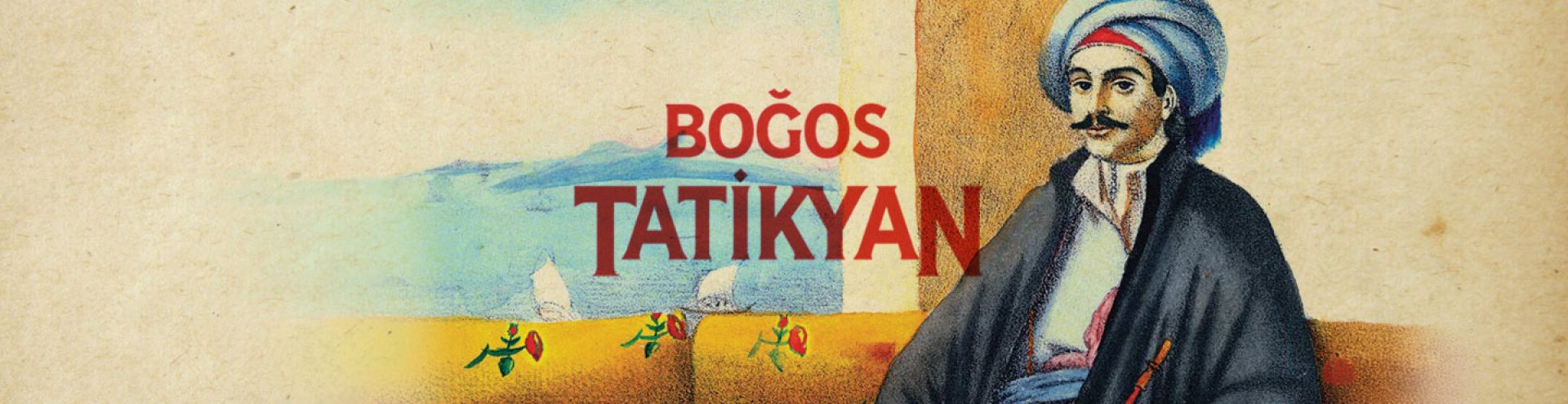
Boğos Tatikyan (1820-?), an Ottoman citizen of Armenian descent, was a prolific painter, lithographer and printer who made significant contributions to the cultural and artistic scene of Izmir in the 19th century. It is believed that Boğos Tatikyan, one of the pioneers of Ottoman engraving, was born in Izmir in 1820 and started painting in the 1840s, but there is no information on his date of death or education (Kürkman, 2004, pp. 76, 193). In the second half of the 19th century and the early 20th century, the name of Tatikyan Printing House is found in the trade yearbooks printed in Izmir on different dates, it is known that it printed in all languages without discrimination, and various records related to Tatikyan Printing House are found in the Prime Ministry Ottoman Archive (Daşçı, 2013, pp. 532, 534). Pamukciyan, mentioning the printing house of Bedros Tatikyan (? - 1883) in Izmir in 1868, states that Bedros's brother Hodja Boğos was a famous oil and watercolor painter, as well as a lithographer, and that he opened the first photography studio in Izmir in 1859 and handed over his lithography studio to his brother Bedros Tatikyan the same year (Pamukciyan, 2003, pp. 312, 316).
Among the publications printed at the Tatikyan printing house was Etude sur Smyrne (C. Oikonomos - B. Slaars), an important source on İzmir. When the book was printed in 1868, Tatikyan Printing House was located at Frenk Street, Avrupa Hotel Passage, number 4-5 (Daşçı, 2012, p. 33). In an 1876 Greek-language trade yearbook dated 1876, the address of the printing house mentioned among the printing and lithography workshops is Eski Yunan Kulübü Pasajı (Eski Rum Gazinosu Ferhanesi) (Berber, 2008, pp. 40-41). The French yearbooks printed between 1893 and 1896 show that it continued to operate at the same address in the same areas. Until the early 20th century, the printing house remained active and is not listed in the 1926 Commercial and Economic Izmir Guide, the first commercial guide to Izmir in the Republican period (Yetkin, 2002, p. 125).
Another source of information about Boğos Tatikyan's identity as a painter is the book in which the American diplomat, writer and painter Samuel Greene Wheeler Benjamin (1837-1914) tells his life story and recollections. Benjamin mentions that while he was in Izmir in 1846, he received painting lessons from a painter named Tatikyan and received advice on shading and quick drawing from nature:
“...He was an average artist, but he knew a lot more than I did, and I was attracted by the subjects he took from life on the street to sell to tourists. He was eager for me to visit him in his studio and see his work. From his patience in describing details, I learned patience and care...” (Benjamin, 1914, p. 71).
Tatikian created paintings that appealed especially to foreign tourists visiting the city and depicted the local characteristics and lifestyle of Izmir. These paintings consist of full-length figures wearing the clothes of people from different professions and different nationalities living in Izmir. In addition to these, Tatikyan also prepared portraits of the Ottoman Sultans in color and gilt and offered them for sale. According to an Armenian newspaper advertisement, these engravings were sold in the engraving house of Boğos in İzmir and in the printing house of Mühendisyan Hovhannes in İstanbul (Kürkman, 2004, p. 76). Clothing albums have attracted interest in Europe for centuries in the interest of the Orient, and these depictions of the exotic atmosphere of the Eastern world were commissioned by ambassadors, wealthy travelers and statesmen, and constituted an interesting range of subjects for countless artists. Tatikyan's engraving albums are held in various libraries, museums and private collections in Turkey and abroad, and are traded at auctions. One of these albums is the Album of Ottoman Sultans in the Victoria and Albert Museum, National Art Library (1852). The costume albums in the Toronto Public Library and the Boston Museum of Fine Arts, as well as the album in the Albert S. Cook Library at Towson University in Maryland, can also be counted among these albums. One of these albums is preserved in the Istanbul Metropolitan Municipality Atatürk Library. The volume, which contains 29 colored engravings by Tatikian, is the same as the volume of the photo albums, albums with different contents and publications sent to the United States Library of Congress during the reign of Abdülhamid II (Daşçı, 2013, pp. 540-541). In these engravings, Greek, Armenian, Jewish, and Turkish women, clergymen, fruit sellers, clerks, fruit vendors, clerks, porters, and figures from many other professions are depicted in a way to introduce the work they do.
Among the local types Tatikyan chose for his engravings, the porters, who were also mentioned with interest by Western travelers in their travelogues, stand out. The importance of porters in Izmir, the busiest commercial port of the Mediterranean, is great. In the narrow streets of Izmir, which were too narrow for cars, porters had a lot of work to do (Figure 1). Tatikyan's figure of the ‘coffee seller’, on the other hand, brings to mind 19th century travelers' accounts of how coffee was served with special care not only in the palace but also among the common people (Figure 2). In one hand, he holds the coffee, and in the other, the transparent glass bottle and the hookah with its red marpucu, which would accompany the coffee. The coffees are being cooked in separate small pots on the embers for three cups, while porcelain cups with handles and saucers are kept warm on top. The coffee, hookah or pipe was served not only to the customers who came to the coffeehouse, but also outside the shop (Daşçı, 2013, p. 545).


According to the dress regulations in Ottoman society, each individual was required to wear the clothes determined according to the community and social status to which he or she belonged. Although often overlooked, according to these regulations, the colors specified for Jews were darker than those of Muslims. Black and red dominated their cotton clothes and shoes. They wore a black or dark cardigan, a loose blue shalwar with a wide belt around the waist, a blue or red turban, and shoes in the same colors (Shaw, 2008, pp. 148, 203). With his striped shirt, blue shalwar, wide-sleeved dark-colored cardigan, black shoes and blue turban, Tatikian's ‘Jewish candy seller’ appears to be in accordance with the dress code for Jews at the time (Figure 3).

In his engravings, Boğos Tatikyan dealt with subjects that would be of interest to foreigners, while unwittingly recording various aspects of the multicultural city and its people, and made important contributions to the memory of the city with these valuable historical documents he presented to future generations. The polyphony created by the Tatikyan Printing House with its non-discriminatory publications of the period was transformed in Tatikyan's paintings into a multicolored city full of life with its Muslims, Jews, Armenians, coffee makers, sugar sellers and garbage collectors.