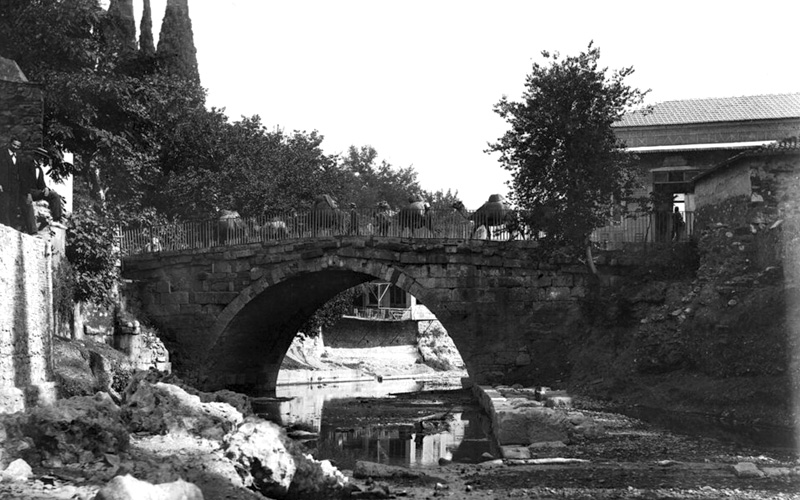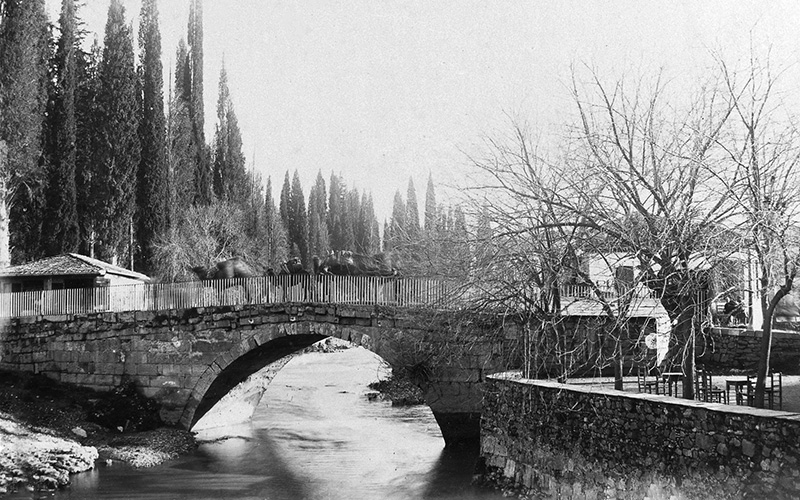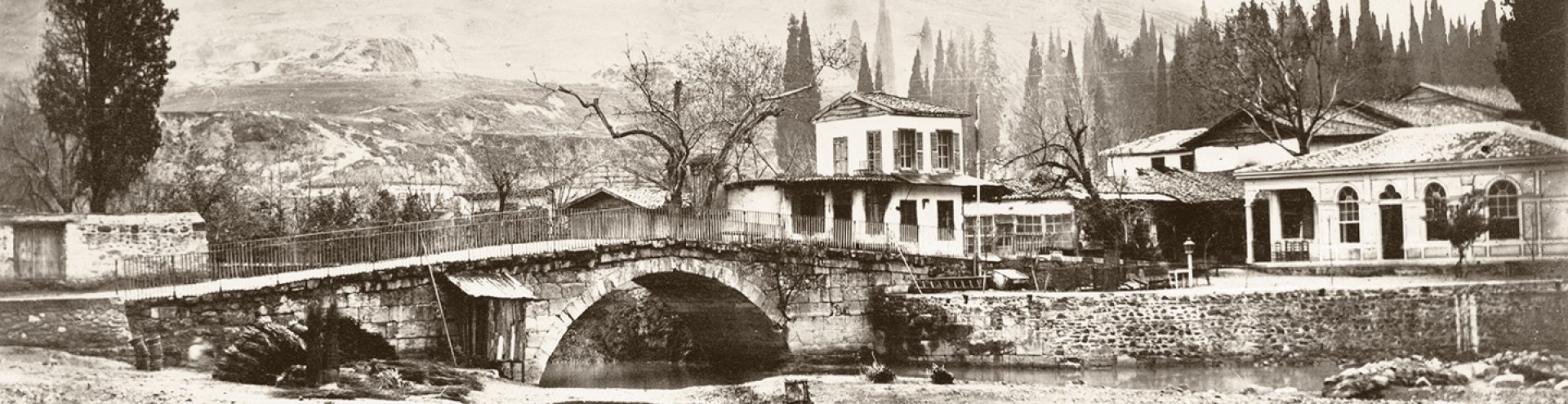
The Caravan Bridge, which connects Izmir's important trade routes and Silk Road caravans to the city, has a long history dating back to antiquity. This bridge, whose exact construction date is unknown, was built to cross the Meles Stream and took its place on the stage of history as a structure where the roads of different civilizations intersected.

The Caravan Bridge was a connection point heavily used by camel caravans, especially in the 17th and 18th centuries. Due to its location, the bridge became a center where customs clearance of goods arriving in Izmir was carried out, caravans and merchants rested, trade was revived and various cultures met.
The bridge attracted the attention of caravans and merchants as well as Western travelers who wanted to explore the East. The Caravan Bridge was the subject of both written sources and various engravings and postcards, especially during the 19th century. In the picture below, we see the Caravan Bridge depicted by the painter Thomas Allom and engraved by William John Cooke during one of these visits.
The famous American writer Herman Melville mentioned the Caravan Bridge in his diary as follows;
“We went up Pagos Mountain [Kadifekale]. We took a wide tour. The interior is littered with stone fragments that make the castle look like a wasteland. Still, it offers an excellent view of the Gulf of Izmir and the city. Inside is a ruined old mosque. The name Boston is carved somewhere. We went down and came to the Caravan Bridge, a large resort and also the city's gateway to the country. Here camels, horses, mules and donkeys cross in a continuous line. Sometimes a horse leads a herd of camels, sometimes a donkey both leads and follows (Melville, 1989, pp.68-71).”
The location of this centuries-old historical bridge was affected by the developments in transportation technologies in the second half of the 19th century. With the commissioning of the Izmir-Aydın and Izmir-Kasaba railway lines, the first railway lines of the Ottoman Empire in Anatolia, the volume of trade carried out by camel caravans gradually decreased. Accordingly, Kervan Bridge lost its importance day by day. Although it has lost its traditional function as a natural consequence of the advancement of technology, Kervan Bridge continues to exist as one of the important landmarks of the city identity.