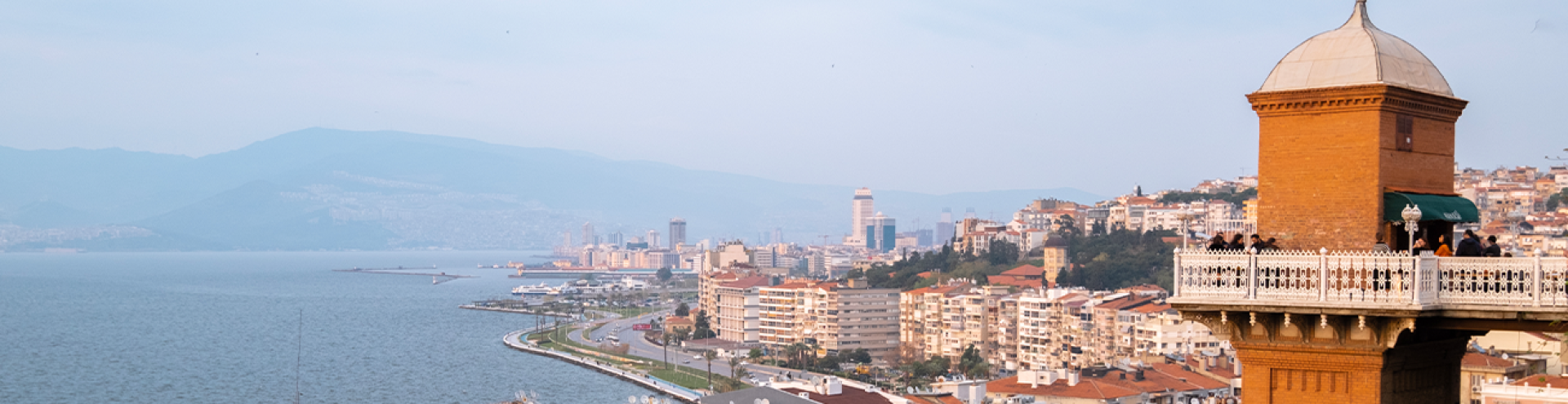
The historic Asansör is one of the first symbols of Izmir that comes to mind. It welcomes you with its splendor among the narrow streets and steep slopes of Karataş. This structure is not only an engineering marvel, but also a living archive of the sociological fabric of the city. For many Izmirites, especially Dario Moreno, with whom it is associated, the Asansör is the most prominent representation of the city's multi-layered, cultured and art-loving spirit. Such icons play a critical role in the construction of an “alternative urban memory” that goes beyond the official narratives of the city. They remind us of the presence of minority identities and the cosmopolitan past in these lands, and keep alive a layer of the collective memory that has almost been forgotten. The story of Asansör dates back to 1907. In those years, it was built by Nesim Levi Bayraklıoğlu to facilitate transportation between Mithatpaşa Avenue and Halil Rıfat Paşa District, which is approximately 50 meters above sea level, after an accident. Beyond overcoming a physical obstacle and providing convenience, the elevator* served the democratization of urban life by shortening the distance between the “down” and the “up” of the city. Even today, when you take that elevator, you do not only overcome a geographical height, you actually take a short journey through the layers of time and culture.


One of the most beautiful passages before reaching the elevator is Dario Moreno Street. These two names - Historical Elevator and Dario Moreno - are inseparable for Izmir residents. Moreno was born in Izmir in 1921 and then captivated the world with his voice. His story reflects the cosmopolitanism of this city. She was born to a Jewish family, grew up in the colorful, multilingual streets of Izmir, then went to France where she became an international star. But the important thing is that wherever she went, she never lost her love for Izmir and her love for Izmir. His voice became the voice of the city. Just like in ’Izmir's Poplars‘, in the shade of the city's poplars, she announced the indescribable longing she felt to the whole world...
As you walk down this street, his immortal songs inevitably echo in your mind. When you take the elevator or watch Izmir from the observation deck, you are greeted by that familiar voice rising from the loudspeakers: ‘My dear Izmir. This is not just a memory, but a sense of belonging. Dario Moreno is the face of Izmir's lost but never forgotten multicultural past. The historical elevator is the embodiment of the mark he left on this city. While the elevator carries people up physically, Dario Moreno's music and story bring us closer to the spiritual and cultural depth of this city.
The most interesting and important aspect of this building and street that should be included in the archives is that it is a rare and still standing sign of the culture of coexistence. Beyond stone and concrete, it is a place of memory (lieu de mémoire).
The Historic Elevator and Dario Moreno Street are not only touristic spots of Izmir, but also a reflection of its sociological identity. One symbolizes overcoming physical distances, the other cultural and emotional distances. These symbols should be preserved as the epitome of the values that make Izmir what it is - tolerance, pluralism and love of art - and their story should be passed on to future generations.
*Owned in 1942 by businessman Şerif Remzi Reyent, the elevator was closed in 1960 after a dispute with the municipality and served as a warehouse. After Reyent's death in 1973, the building was abandoned to its fate and donated to the Izmir Metropolitan Municipality by his niece Ayla Ökmen after sitting idle for many years.