Evliyâ Çelebi (1611-1684?) is undoubtedly one of the world's greatest travelers. His ten-volume Seyahatnâme, a colorful account of the places he traveled for half a century, is a treasure trove of information on the cultures, languages and dialects of not only the Ottoman lands but also the surrounding countries. Initially known only to the court elite, the Seyahatnâme was translated into English by the famous historian Joseph von Hammer-Purgstall in 1834 and introduced to the world of science. Today, it is still being reprinted in various languages and is the subject of meticulous research in many fields due to the richness of its content.
Izmir and its surroundings are included in the ninth volume of Seyahatnâme. As Evliyâ Çelebi relates at the beginning of the ninth volume, after returning from his trip to Europe, Evliyâ Çelebi, following the advice of his father and teacher Mehmet Çelebi, whom he had seen in a dream, to go on pilgrimage, sets off from Istanbul in 1671 to Mecca and Medina. He visits the cities of Western Anatolia as the first stops on this long pilgrimage. As in the other parts of the work, the section describing Izmir and its surroundings contains extensive information about the city's history, geographical features, architectural structures and social life.
In our previous article, we discussed the harbor castle in the lower city from the pen of Evliyâ Çelebi. Our traveler's second stop in Izmir city center was the Old Castle in the upper city:
“From this castle (the Harbor Castle), it is three thousand steps to the old castle on the mountain from the upper east side through the city, all the way through the city.”
We don't know if it was three thousand steps, but we can safely assume that our traveler walked along the Kemeraltı Bazaar, which at that time formed the sea shore by encircling the inner harbor in an arc, and ascended towards Kadifekale.
“This castle is on a rock and has no moat on all four sides. In ancient times this castle was an inner castle. But its old castle surrounded the lower city. It was a big castle whose gates and castle walls are clearly visible in many places. Some of its towers and bastions remain inside the houses.”
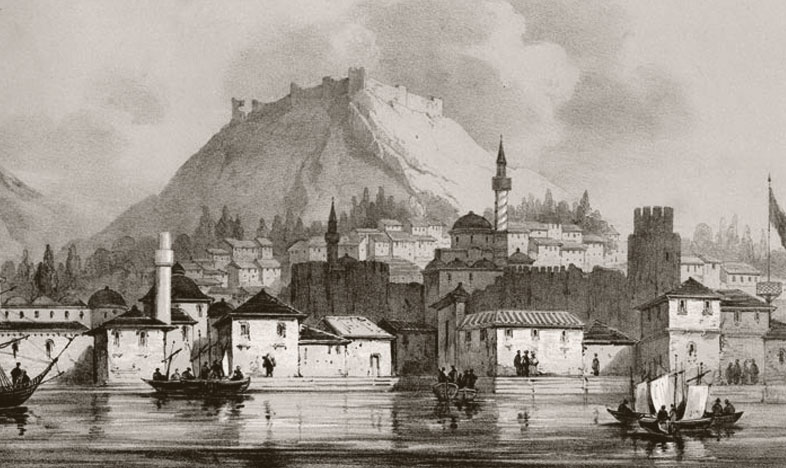
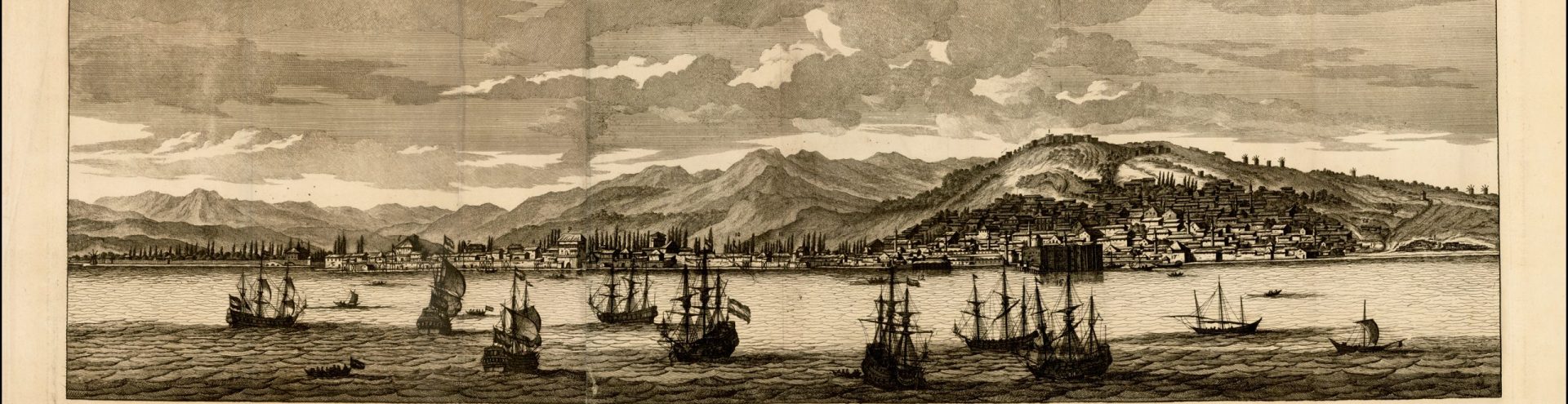
Indeed, at that time, the city was covered with settlements from the harbor to the skirts of Kadifekale Mountain. Many travelers who visited Izmir gave the same information and some painters painted this panorama.

The ancient Pagos Castle, or Kadifekale as it is known today, was built on the 186 meter high Pagos hill southeast of the city center. The surrounding walls were built in the late 4th century BC and early 3rd century BC. The area, which became the Acropolis of ancient Smyrna, was the center of the city's defense system, as well as its most important sanctuary. The city walls were also used during the Roman period. During the late Byzantine period, destroyed sections of the walls and towers were repaired and new walls and towers were added in the 13th century AD. This upper city was conquered by the Aydinoglu Principality in 1317 and remained firmly under Turkish rule in the period that followed. Apparently, by the time of Evliyâ's visit in 1671, the inhabitants had ceased to live within the castle and had settled along the hillside towards the city on the coast:
“This castle is on a low hill with a slope and rocks, built by a wife named Kaydefa Queen, which Alexander the Great built out of fear, and it is a strong, durable, protected and five-cornered large building. Its circumference is 2,700 feet. Each stone is the size of an elephant, a strange structure. But ever since the castle by the sea was built, people have migrated from this castle to the lower city and vineyards and gardens have remained in this castle. The inns, baths and bazaars have been ruined.”
Evliyâ Çelebi reported that Kadifekale was built by Queen Kaydefa. Belkis, the Queen of Sheba, or Queen Kidefa-Kaydefa is the legendary ruler of the prehistoric Kingdom of Sheba, which is supposed to have ruled in the 10th century BC in what is now Abyssinia (Ethiopia) or Yemen. Modern archaeology is skeptical about the existence of this kingdom.
“It is the structure and throne of a queen named Kaydefa Melike, contemporary with Alexander the Great. After a long time, Anatolia turned into principalities during the reign of the Seljuk Sultan Alaeddin, and one of Alaeddin's viziers, Ali Bey, son of Sigla, a famous and useful vizier, conquered this Izmir from the hands of a queen named Izmirne, also from the lineage of Kaydefa, and conquered and conquered it and annexed it to the Islamic countries. It is dated when Timur Khan devastated Izmir.”
Evliyâ reported that Queen Kaydefa, whom he introduced as a contemporary of Alexander the Great of Macedonia, came to İzmir and built the castle on the hill out of fear of Alexander the Great. While our traveler gives information about the beliefs and legends of the people of the regions he visited based on his own observations and what he heard, sometimes he also conveys what he learned from written sources. Apparently, Evliyâ conveyed one of the legends about the foundation of İzmir and Kadifekale, as he heard from the people around him.
“This upper castle has a solid gate with iron wings facing west. As one enters the gate from the outside, there is a carved image [statue] of Kaydefa as a corpse made of white raw marble under a small arch on the tower on the right side, which is two men high. When one sees it, one thinks it is alive and admires it. Wherever you go, it seems to be looking in that direction. If you smile, it looks like that, if you cry, it looks like crying, it is a strange spectacle. However, he has no body below his neck. It is a fairy-faced luminous face depicted with a necklace around her neck, a red face, earrings in her ears, curly hair on her head, kohl-rimmed gazelle eyes, but no soul.”
Evliyâ Çelebi, a master storyteller, described the statue he saw with the utmost vividness. As much as the story of Queen Kaydefa is worth telling, it is equally necessary to mention the whereabouts and physical characteristics of her statue.
“There is an exemplary tree in front of the gate 50 steps away from this castle gate. I have traveled around the earth like seven planets in seven climates, I have never seen such a strange and strange tree. It resembles a hedgehog tree. But by God's command, a kind of pure oil comes out of it, a cure for 72 diseases. Its leaves are a gift from God, created in a different way. “Mother Kaydefa planted it with her own hand,” Yanvan wrote in his history. Indeed, its leaves and branches are like a tree that has lived for many thousands of years, but they are still fresh.”
Kadifekale Mosque
When the Turks captured the upper castle of the city, a mosque was built inside the castle, as was the custom. According to the inscription recorded by Evliyâ Çelebi, which has not survived, this mosque was built in 1308/1309 by Ahmed Oğlu Hacı İlyas, the Kadi of Izmir Castle. It is perhaps the oldest Turkish-Islamic building in the city, dating back to the early years of the conquest of Izmir by the Aydınoğulları.
“There are no houses inside this castle gate. But there are many fields and vineyards. There is a well-built mosque. This is the date of its gate: “Hâzihi'l-medresetü'ş-şerif ve çamiu'l-latîf el-abdü'z-zaîf elmuhtâc ilâ rahmetillâh, al-Hâj İlyas ibn Ahmed, afallâhu anhüme'r- Rabbussamed, al-kâdî bi-kale-i İzmir, azzetehallâhu(?) taâlâ ani'ttedmîr. Sene semâna wa seb'a mie.”
Evliyâ Çelebi stated that after the lower castle (Port Castle) was taken, the people migrated to that side and the congregation of the mosque was limited to the castle officials. This mosque, which was never used after a while, was thought to be the remains of a chapel-church there by foreign travelers and was even associated with St. Polycarp. However, architectural and archaeological information obtained from recent excavations support that the building was the first mosque built in Kadifekale in the early 14th century.
Inner Castle
“There is an inner castle on the right corner of the castle on the right side of this mosque, Sultan Mehmed the Conqueror divided it from this big castle and made it an inner castle, and the people who live in 20 houses with 20 nafs and 20 tiled roofs are the congregation of this mosque. It is a very strong small inner castle. It is quadrangular in shape and 800 feet in size. But the outer wall is still from the old fortress wall. However, Fatih divided it from the inside and made it a small inner fortress with a layer of wall. It has a small iron gate facing the qibla.”
Built during the reign of Sultan Mehmet the Conqueror, this inner fortress housed the military force important for the defense of Kadifekale.
“Since its walls are very strong and fifty architect's cubits high, the goods of 100 Egyptian treasuries of all the notables of Izmir are kept here. For the lower city of Izmir was well built, but not protected, and was a nest of verminous levies. Because of the fear of Jalali and harami, the goods and valuables of all the dignitaries are hidden in this upper inner castle..”
Celâli rebellions and banditry were undoubtedly a major security problem for all Anatolian cities. From time to time, the cities suffered great damage in the rebellions that broke out. Therefore, Kadifekale served as the most protected hill in the city for military purposes for a long time. By the mid-18th century, it had lost all its functions in the defense of the city and was completely abandoned.
It is said that travelers who came to Izmir, even if they sweat blood along the way, would not leave Izmir without climbing up to the upper castle and watching the city once from Kadifekale, which completely dominates the Gulf of Izmir.
Let us end with the words of Evliyâ: “Between this castle and the castle on the seashore, the city of Izmir is a big city and a new pier.”