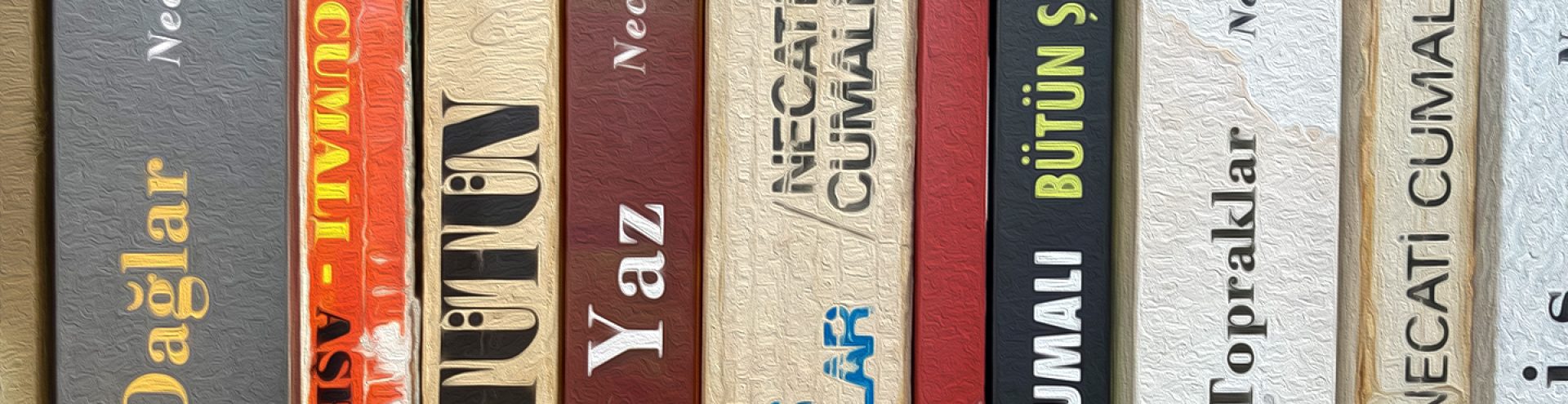
People carry traces of the streets they walk, the stones they touch, the leaves blown by the wind. A place is not just a background; it is the place that resonates in one's heart, nourishes one's dreams, and is the birthplace of one's soul. Gaston Bachelard's As he says, a house is not just four walls; there is a childhood, a fear, a hope hidden there. Our home is our first universe. Literature is the most elegant voice of these spatial emotions.

An artist's language, dreams and works inevitably bear traces of the land where they grew up. The place is not just a backdrop; it becomes the pulse of the narrative, the geography of emotion, the voice of memory. Just like Ahmet Hamdi Tanpınar's cities, or as Necati Cumalı said: “The setting of my works”, like Urla and Izmir.
When we look at Cumalı's works, we follow step by step how this invisible weave between space and memory turns into a narrative. Because in his lines, space speaks in silence; a stone house, a dock or a seashore becomes the real hero of the story.
Necati Cumalı was born in Florina on January 13, 1921; he settled in Urla district of Izmir with his family when he was only three years old. His real name was Ahmet Necati Acar, but years later he chose a surname more suitable for his poetry and took the name ’Cumalı“. This name is a nod to his mother's hometown of ”Cuma“, an old settlement near Kayalar.
His childhood was spent in Urla, among the stone streets, windy afternoons and the silent tables of immigrant families. This period formed the cornerstones of his literary memory.
In his childhood years, when he learned Turkish with a Rumeli accent, words not only carried meaning for him, but also traces of migration, loss and re-rooting.
Cumalı completed his secondary education at Izmir Muallim Mektebi and then his high school education at Izmir Atatürk High School. His law school journey started in Istanbul and ended in Ankara. He worked as a lawyer for a period of his life. The enchanted call of writing and literature made Necati Cumalı put aside his lawyer's robes and reshaped all the broken pens in his mind.
His literary adventure, which began with poetry, eventually spread to short stories, novels and theater. His works became the expression not only of individual feelings but also of the pains of a generation and a society. His poems echoed with the sensitivity of the Imbat, his novels with the yellowing hopes of tobacco fields and his stories with the stony roads of Karaburun.
Urla in Cumalı's literary world, closed is a space; a closed, abandoned “mother” house with windows. Childhood, loneliness, the effort to put down roots take shape here. The stone houses and narrow streets of Urla are not just decorations; they are the deep cracks of the child's memory.
In Tobacco Time Urla is the stage of poverty and solidarity:
“As the tobacco grew, so did we.
But each season would bring us another lack.”
(Tobacco Time, 1956)

Izmir is a place of change and hope in Cumalı's works. open of the city. Walks along the promenade, hair blowing in the wind and the changing city skyline... Especially Guler's Love Izmir becomes a symbol of love and individual freedom:
“The wind of Izmir brought new hopes even at night.
Here, even loneliness would have a different resignation.”
(Güler's Love, 1982)
Cumalı's characters move from the introverted, shelled silence of Urla to the openness of Izmir that speaks to the wind. This movement is not only a spatial but also a spiritual journey. This spatial duality also determines the spiritual transformation of Cumalı's characters. Those who stay in Urla walk in Izmir; those who are silent in Urla talk in Izmir. Sanatorium The following lines from his poem are the simplest indication of this transition:
“Hope was the open window
If it was closed, the wind wouldn't come in
I loved Izmir for the first time in a sick bed.”
(On the Back of a Green Horse, 1987)

Izmir is not just a port city; it is a song of life where languages, cultures and beliefs mingle.
In Izmir, literature blended with journalism, multilingualism and the desire for modernization. Nowruz, Service, Harmony newspapers did not only report news; they also created a literary language and memory.
Halit Ziya Uşaklıgil, published in Izmir in 1886 Service When she started to publish her novels in the newspaper, she was both a journalist and a writer. Every sentence she wrote foreshadowed Izmir's social change, new classifications and the transformation of women's identity. But she did not do this in a dry news language, but through the fiction of the novel, through the perspectives of the characters.
The balconies of French-speaking families in the Frankish neighborhood, coffeehouses filled with the satires of Şair Eşref, the first books published by Armenian and Greek printing houses, the literary columns of Jewish newspapers...
Attila Ilhan, “I'm obliged to you”, he was also describing Izmir's youth. Tarık Dursun K., Samim Kocagöz narrated the people of Izmir.
In the Republican era Yeni Asır, Demokrat Izmir, Ege Ekspres Poetry columns and literature pages were opened in the pages of newspapers such as the Turkish newspaper. Writing existed not only to inform, but also to refer, to make us think, to remind us and to move us.
In this city, every street, every marketplace and every seaside is the line of a poem and the beginning of a story. Izmir literature is always a hopeful, vibrant, plural language. And Cumalı is one of the warmest, most sensitive, Rumeli accented and loud voices of this language.
Izmir is a city of migration, change, resistance and new beginnings. Therefore, Izmir is not just a geography; it is the womb of memory and the motherland of literature.
In Necati Cumalı's pen, Urla is the silent stones of loss; Izmir is the windy avenues of hope. His lines show how space shapes the human soul. Therefore, Cumalı's works are not only a panorama of a period; they are also an atlas of memory.
“I didn't write about Izmir.
Izmir was what I wrote.”
That's why today, when we walk along Kordon, if a shadow passes over our shoulders, we know that it belongs not only to a poet, but to this city itself.