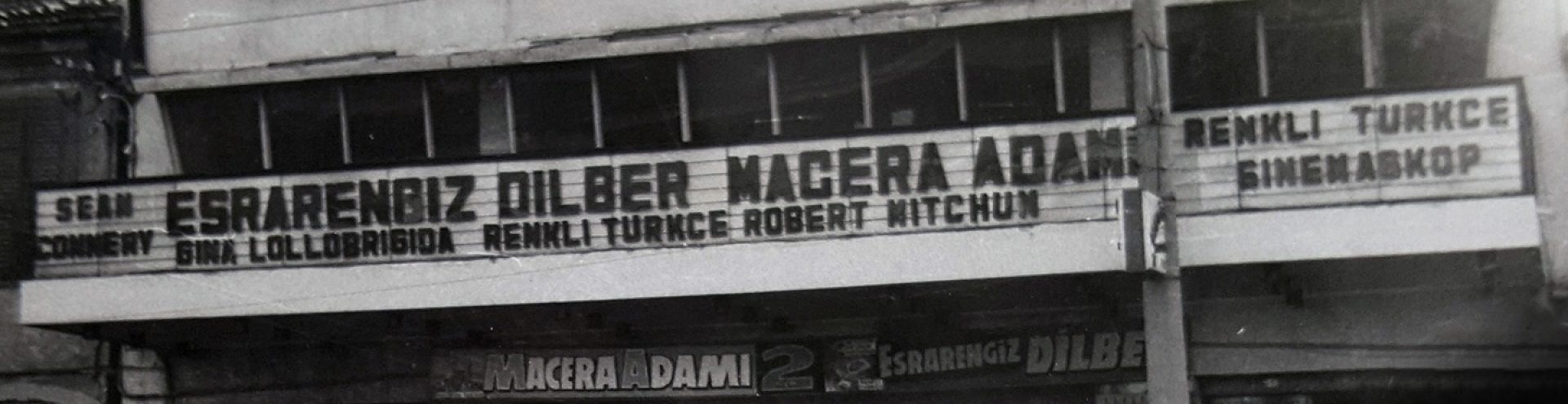
Izmir has a long and vibrant history of cinema that begins almost with the invention of cinema. The first public film screenings took place at the Apollon Club in the Frenk neighborhood in 1896, just one year after the Lumière Brothers’ famous Grand Café screening in Paris and the same year as the arrival of cinema in Istanbul. İzmir (then known as Smyrna), one of the most important trading ports of Asia Minor and one of the most cosmopolitan cities of the Ottoman Empire, had an ethnically rich population of Greeks, Turks, Armenians, Jews and Levantines. This diversity is also reflected in the city's neighborhood structure; each ethnic group has its own neighborhood bearing its own name. The Frenk Quarter, where European Levantines or non-European economic elites reside, is the commercial and cultural center of the city. Especially Kordon is the heart of the Levantine lifestyle with its cafes, social clubs, salons, theaters, hotels and consulates. In the words of European travelers, it is the “little Paris of the East”. The first established movie theaters open in Kordon in 1908. In fact, one source from the period states that there were four separate movie theaters in a twenty-meter area between the Kraemer Pub and the Sporting Club. Ciné Pallas, Lux, Cinematographe Paris, Pathé and Theater de Smyrne are among the first movie theaters in the city.

By 1914, movie theaters had opened in districts such as Karşıyaka, Güzelyalı, Bornova and Basmane, and their number had reached 15. Almost all of these cinemas, also referred to as ’cinematograph houses’ in the press, belonged to “non-Muslim” communities, especially Greeks. Opened in 1913 to generate financial income for the National Library, the Milli Kütüphane Cinema and Theater (later Milli Sinema (National Cinema) and from 1926 Elhamra (Elhamra)) is the only Ottoman-owned movie theater.

In those years, movie theaters were among the most popular entertainment venues in the city after coffee houses. 1913 French Cine-Journal The article published in the magazine, which takes its title from the old saying “When things go wrong, Smyrna has fun”, pays special attention to the cinema culture in Izmir. The article states that there were five large cinemas in Kordon with a total capacity of over 4,000 spectators, each showing first-run, different movies. Moreover, these movies are renewed at least twice a week. The demand for movie theaters can be clearly seen from this information. While men and boys make up the majority of the audience, non-Muslim women are the majority of moviegoers. Muslim women can only watch movies in special sessions reserved for women.
Within the multicultural structure of Smyrna, movie theaters were sometimes the scene of social tensions during the war years. At that time, the movies were silent and the intertitles were usually in French, sometimes in Italian or English. On the eve of the First World War, the absence of Turkish (Ottoman Turkish) in the intertitles makes the cinemas in Kordon a target for Turkish nationalist circles. For example, in 1913, Young Turks from the Turkish Quarry demanded that the intertitles also be presented in Ottoman Turkish. When they receive no response to their demands, they disperse to different cinemas every evening with a group of 40-50 people and sabotage the screening with whistles and noise as soon as the movie starts. Although theater owners try to defuse the situation by handing out flyers explaining the plot of the movie, tensions are rising. At one protest, the French consul even tells security officials to remove the Turkish students gathered in the theater or he will bring troops from a French ship in the harbor. The students leave the theater to avoid further tension.
Almost all of the Kordon cinemas are destroyed in the Great Fire of Izmir in 1922. Only Ciné Pallas and Lux, which remained in the area where the fire did not reach far enough, partially survived. However, with the Turkish takeover of the city and the proclamation of the Republic, these two cinemas lose their old identities over time. Ciné Pallas becomes Tayyare Cinema and Lux becomes Sakarya Cinema. Thus, Izmir's first multilingual, multicultural cinema era comes to an end, and another cinema culture slowly takes its place.
Cemil Filmler, one of Turkey's first film producers and cinema operators, tells in his memoirs that in 1923, Muslim women in Izmir were able to watch movies with men for the first time at the Ankara Cinema (later renamed Tan and İmren) in İkiçeşmelik. According to Filmer, this happened with the direct intervention of Atatürk, who was in the audience. Today, this building, which is used as a spotlight shop, still contains traces of the old movie theater.
In 1923, Ciné Pallas also hosts a “first” for Turkish performing arts. According to sources, on the night of July 31, 1923, Bedia Muvahhit, again with Atatürk's support, performed in this hall still covered with the ashes of the fire. Penal Code She plays the role of Sacide in the play. With this performance in the presence of Atatürk, Muvahhit and Ciné Pallas go down in history as a turning point for the emancipation of Muslim women and women artists in Turkey. After a while, Ciné Pallas becomes the property of the Tayyare Society and is renamed Tayyare Cinema. Today, the Tayyare apartment building rises on the site of this cinema.
İzmir's cinematic adventure gains its main momentum in the 1950s, as is the case across Turkey. In this period of radical transformations from politics to economy, urbanization accelerates and cultural life diversifies in Izmir. The city's entertainment map concentrates especially in three centers: Kültürpark, Kordon and Basmane. The lack of entertainment options other than cinemas and casinos, as well as the fact that cinemas are much cheaper than casinos, makes the cinema attractive for the public. Tayyare Cinema in Kordon, Yıldız, İkbal, Club and Büyük cinemas in Basmane are the prominent entertainment venues of the period. In time, a wide network of cinemas is formed, extending from Alhamra in Konak to Yeni, Lale, İnci, Saray and Tan cinemas in Mezarlıkbaşı, and from Şenocak in Eşrefpaşa to Köşk Cinema in Küçükyalı. In the 1960s, the number of movie theaters in the city exceeds 60. During this period, the entertainment tax collected from movie tickets constituted the largest share of the municipality's revenues, which clearly shows how popular cinema was. Izmir's warm climate also makes summer open-air cinemas a special attraction. By the 1970s, there were over eighty open-air cinemas in the city. All this proves that Izmir was truly a ’movie city’ in the past.

Going beyond the numbers, the Alhambra Cinema was not only one of the most ‘elite“ cinemas in Izmir until it was transformed into the Opera Theater in 1979; it is a building that can be compared to the halls with magnificent decorations called ”picture palaces“ in the world in the early days of cinema. The interior of this 840-seat theater is decorated with oriental-style oil lamps and tile panels. The ceiling under the balcony is decorated with Turkish embroidery.
The Tayyare Movie Theater, which was restored in a modern style between 1933 and 1934 by Ernst Arnold Egli, one of the architects of the Republican era, is one of the “elite” theaters of the period. Consisting of a hall, two balconies and seven boxes, this building has a total capacity of approximately 370-380 people. Equipped with advanced sound and air conditioning systems, Tayyare stands out with its technical infrastructure and modern architecture.
Unlike other theaters, Alhamra and Tayyare usually show foreign films with subtitles, single and first-run foreign films. Moreover, they are pioneers in keeping up with innovations in cinema technology. For example, the American production that started the three-dimensional movie craze in the world Bwana Devil (1952), on December 29, 1953 at Tayyare Movie Theater Demon of the Forests is being released under the title.
The panoramic screen application is used at the Elhamra and Yeni Sinema in 1954. A year later, in 1955, the Elhamra becomes the first cinema to bring cinemascope technology to Izmir.
The Lale, Yeni, İnci, Saray and Tan cinemas in Mezarlıkbaşı are more “modest” theaters. The dominance of these cinemas in the region is broken in the 1950s with the opening of Yıldız, İkbal, Kulüp and Büyük cinemas one after the other on the Basmane-Tepecik line. The Büyük Cinema, opened in 1951, becomes the largest indoor cinema in Izmir with a capacity of 2180 seats. Yıldız, another remarkable movie theater in Basmane, whose building has survived until today, has a capacity of 1800 seats. Designed in 1953 by an Italian architect, this theater is also famous for its retractable ceiling doors, which are still in operation.
Its proximity to the train station and bus terminal makes Yıldız Cinema an attractive address not only for Basmane residents but also for audiences from other parts of the city. Attracting a wide range of audiences from all walks of life, including wealthy families, this cinema is one of the few places that can bring together the lower and middle classes and the social and economic elite in the same theater.

In this respect, it has a unique place among the “elite” halls of the period such as Elhamra and Tayyare. However, the audience profile can vary depending on the time of day and day of the week. Especially on Saturday nights, the area around the movie theater transforms into a different world. Cars line up in front of the theater, elegantly dressed ladies and gentlemen appear at the entrance. Even the mayor and the governor are among the weekend regulars.
In its early days, Yıldız Cinema not only featured first-run dubbed American films, but also productions from continental Europe (especially Italian, German and French) and local cinema such as Zeki Müren and Ayhan Işık films. During the summer months, the Istanbul Municipality City Theater also hosts events such as performances by the Comedy Section and the French Moulin Rouge Revue. During this period, an important cinematic event takes place in this theater: The movie that would later take Turkey by storm Idle (Awara, RajKapoor, 1951) is first screened on November 22, 1954 at the Yıldız Cinema in Izmir. The movie has been well received, reaching 150,000 viewers in three weeks, far exceeding expectations. Until the beginning of the 1970s, Yıldız Cinema is home to romantic comedies and adventure films starring European and Hollywood stars. Sinbat, Spartacus, Ben-Hur and Ten Commandments big productions like this; Doctor Zhivago’from James Bond’a, Pink Panther’from Barbarella’With a rich program of screenings ranging up to 'The Cinema of Izmir', it feeds the people of Izmir's passion for cinema.

Although it had to change its screening policy due to the crises in the country and the cinema industry, it managed to continue its existence as a cinema until the end of 1988. From 1989 until 2020, when it was purchased by the Izmir Metropolitan Municipality, it continued to take part in the social life of the city under the name ’Yıldız Sports Facilities“, especially as an astroturf field.
From the 1950s to the mid-1970s, going to the movies was a collective act, usually done with friends, family members or neighbors. Sometimes this togetherness is born out of a desire to spend time in a more festive and enjoyable way, and sometimes it stems from the difficulties of going alone. Cinema is an alternative public space, especially for women; it is an opportunity to go out and participate in social life. However, this is not always an activity that can be done easily. According to the oral history interviews, in those years, especially among young women, the fear of being harassed on the street or in the movie theater was quite common. When conservative attitudes towards women's visibility in the public sphere are taken into account, it becomes almost impossible for women to go to the movies alone.
Going to the movies is an event in itself, especially for women. Which movie to go to is sometimes planned days in advance, anticipated with impatience and excitement. Even if it is not very special, elaborate outfits are chosen; the movie theater turns into a kind of going out ritual.

As it can be understood, the moviegoing experience in the past is not just about looking at the screen. As everyday spaces where large crowds gather, movie theaters offer a viewing space beyond the screen. Some brave, some timid glances wander around the theater, the foyer or the ticket queue; people ogle each other, looking for opportunities to meet and socialize. Sometimes intimacies that are not possible in the public sphere are tried to be realized in the dark privacy of the auditorium.
On the other hand, the visual splendor and sense of reality, especially in some foreign films, captivated the audience of the period. A movie set in the glaciers made the audience feel really cold, a ship sinking in the open sea made them afraid of taking the ferry for days, or a tragic love story made the whole theater cry, to name just a few examples mentioned in oral history interviews.
The audience's relationship with movies is not limited to the theater. The clothes, hairstyles and attitudes seen on the screen are carried into daily life; the movies become the subject of conversations for days, and cinema spreads into social life. Some movies are even perceived as “modernity” lessons where urban and modern life culture is learned. In short, for many, cinema was not just a few hours spent in a dark theater. In those years, cinema offers a multi-layered experience of life itself and takes its place in the memory as one of the most vibrant and shared moments of city life.

The vibrant cinema scene of the 1960s and 1970s begins to transform in Izmir, as it did in Turkey in general, in the mid-1970s. Political and social turmoil, economic crises and structural changes in the country deeply affect the cinema industry. In the mid-1970s, developments such as the spread of television broadcasts in the city, the successive devaluation of the Turkish lira, restrictions on film imports in 1974, and the opening of the first video club in 1979 lead to significant transformations in İzmir's cinema scene. As families begin to withdraw from movie theaters, the industry is dominated by ’sex films’, arabesque films and comedy films with large casts. Although these seem like solutions to the crises and the declining number of viewers, cinema continues to lose its old charm day by day. Beginning in 1987, big American film companies such as Warner Brothers and United International Pictures are allowed to open branches in Turkey, which puts the sector in even more difficulties. During this period, relatively new cinemas such as Çınar, Sema, Şan, İzmir and Konak rise, while old movie theaters begin to close down one by one. With the effect of urban transformation, these theaters are transformed into business houses, apartment buildings or buildings with non-cinema functions such as carpet pitches.

The disappearance of old Izmir cinemas, some of which are almost completely forgotten, while others still live on in the memories of a generation, is not unique to this city. Urbanization policies, economic and technological transformations and changing cultural habits have led to a similar process all over the world. While we may not be able to physically bring back lost cinemas, we can insist on remembering them; we can reconstruct their stories through various methods and initiatives; we can protect them and pass them on to future generations. Cinema closes, memory remains. And memory is always a field of struggle.