Having risen as an important port and trade city in the 17th and 18th centuries due to the economic developments in Europe and the capitulations, İzmir became a favorite city for companies with foreign capital in the 19th century. The Levantines who settled in the city entered into close commercial relations especially with Jews and Greeks. The 1838 Baltalimanı Trade Treaty further increased the role of İzmir in international trade. In the 1850s, the number of British merchants in the city was over a thousand. Seventeen countries had consulates in Izmir, where merchants from twenty different countries did business. The Izmir-Aydın railroad, which began construction in 1858, passed through Seydiköy (Gaziemir), Torbalı and Aysuluğ (Selçuk) before reaching Aydın in 1866. In the following years, branches of the line continued to Buca, Bayındır, Tire, Ödemiş and Söke. The Izmir-Kasaba railroad line, built in the same years, reached Kasaba (Turgutlu) in 1866, first connecting Bornova and Karşıyaka, then Menemen and Manisa. Thanks to these first railroads in Anatolia, the agricultural riches of the Greater and Lesser Menderes plains and the Gediz plain flowed into the port of Izmir. By the 1870s, İzmir had a share of % 30 in the Ottoman Empire's foreign trade. The city had gained importance especially in terms of exports. In 1873, % 20 of the empire's imports and % 43 of its exports were realized through this port.
During the years when İzmir was of exceptional importance as a port and commercial city, the Land Law of 1866 liberalized the sale of land to foreign citizens, and foreign investors turned their attention to the lands in İzmir's sub-region. Accordingly, especially British investors became the owners of many lands in Kuşadası, Aydın, Tire, Bornova, Buca, Nazilli, Bergama, Menemen, Torbalı and Ayasuluğ [Selçuk] in the second half of the 1870s.
In 1876, the abdication of Sultan Abdülaziz and then Sultan Murat V, followed by the accession of Sultan Abdülhamid II as the 34th Ottoman sultan, opened the door to a new era. During his thirty-three-year reign, the Sultan played an active role in domestic and foreign policy. One of his noteworthy initiatives for İzmir was the farms he acquired in the Küçük Menderes basin.
Before Sultan Abdülhamid II, most of the land stretching from the Torbalı Plain to Tire belonged to Baltacızâde Artistidi Bey, a member of the Assembly of Finance. These lands, which included twenty villages and approximately 30,000 acres of agricultural land, were seized by the Ministry of Finance due to Arisditi Bey's debts and later transferred to the Treasury-i Hassa, the personal treasury of Sultan Abdülhamid II. During this transfer, which took place in 1881-82, the sultan paid a total of 33,000 liras for the eleven farms in the Torbalı district.

In the administrative structure of those years, some of these farms belonged to the Torbalı sub-district and some to the Tire kaza. The villages in the Torbalı sub-district were Tepeköy, Hamidiye [Özbey], Yeniköy, Ahmetli, Yaylayakası, Arapçı [Pamukyazı], Mecidiye-Sepetçiler [Çaybaşı], Ifci and Meşhed [Şehitler]. Later, Ertuğrul, which was separated from Tepeköy and became a village, was added to these. The center of the farms under the Tire kaza was Subaşı. Together with this village, these lands, which also included Kırbaş, Naime, Tulum, Bülbülderesi, Yeniçiftlik, Işıklar, Ayaklıkırı and Mahmutlar, started from the borders of Torbalı district and formed the western part of Tire kaza.
Acquiring land in places like Mosul and Jerusalem, “to prevent foreign ownership of land” It is also understood that Sultan Abdülhamid II acquired land around Izmir for the same purpose. As a matter of fact, with this move, the sultan protected significant amounts of land against foreign plunder and secured them against the possibility of an invasion. On the other hand, these farms also brought about radical changes in the economic, cultural and social structure of the region. The sultan had a mosque and an elementary school built in almost all of the farms from his personal treasury and also built fountains, pools and water networks in some villages. All of these are referred to in documents as meberrat-ı seniyye (charitable works of the sultan). The mosques and schools were named after members of the Ottoman dynasty, educational methods (usûl-i cedide), which were considered new for the period, were applied in the schools, and girls and boys were educated in the same classes (mixed). The Sultan also covered the educational expenses of these schools from his personal treasury.
The urbanization of today's Torbalı district is directly related to these farms. Instead of the village of Torbalı, which was not part of the farms, Tepeköy, which was part of the district, gained a centralized character over time. The weekly bazaar started to be held in this village, the sultan built two mosques and two schools in this village, and the farm management and production facilities were established in this village, which laid the groundwork for Tepeköy to become a center. As a matter of fact, the establishment of the first municipal organization in Torbalı district in 1911 during the Second Constitutional Monarchy period under the name of Tepeköy Municipality was a result of these developments.

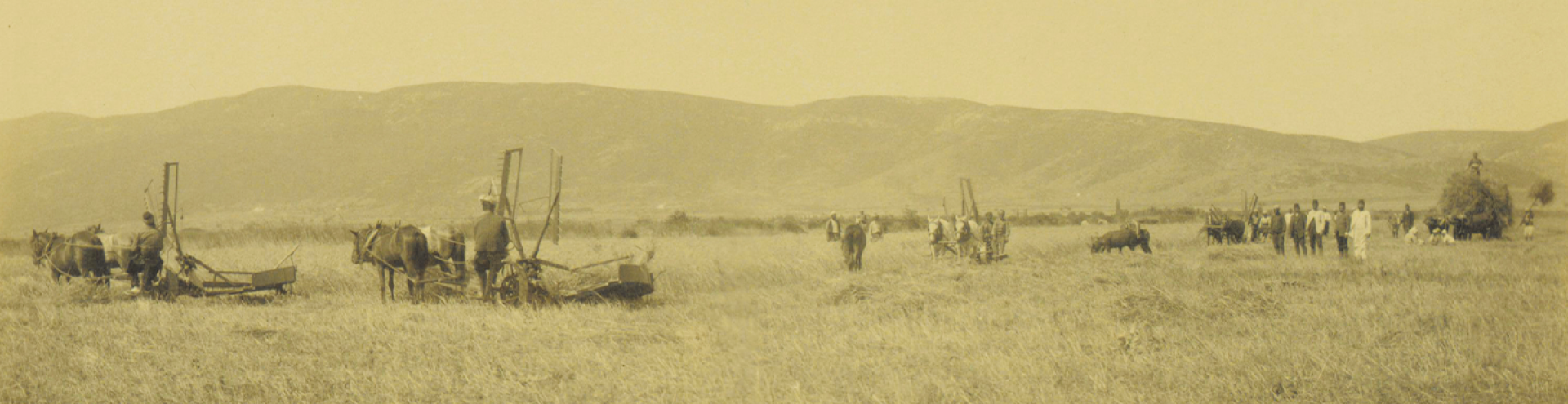
In these farms, called Çiftlikât-ı Hümayûn, new agricultural techniques were applied with agricultural tools imported from Europe, and the region was introduced to new production techniques. The horse races organized every year on Hıdırellez from 1894 onwards, which emphasized local characteristics as an alternative to the Levantine horse races in Paradiso (Şirinyer), are also noteworthy in terms of the role played by these farms. In these horse races, unlike the Levantine horse races held at Easter, Ottoman anthems and flags were emphasized and local horsemanship was encouraged. In the following years, during the five-day agricultural exhibitions and fairs organized simultaneously with the horse races, local people from Izmir, Aydın, Manisa, Ödemiş, Söke, etc. flocked to Tepeköy and had the opportunity to see new agricultural tools and production techniques, and quality production (agricultural products and livestock) was encouraged through competitions. In addition to traditional sports (javelin, pehlivan wrestling), modern activities (bicycle and cross-country races, western-style music, lottery) were also offered to the local people on horse racing days. The building built in Tepeköy in those years for the horse races and the pine grove created in the 1890s are important parts of Torbalı's social life today as they were in the past.
In the last year of the Sultan's reign, Tepeköy Farm appears to have been of remarkable importance as an agricultural complex. In 1908, the farm had 1 administrative office, 2 cotton warehouses, 89 shops, 2 inns, 1 station, 2 salhane, 1 insect house, 3 mills, 3 bakeries, 1 market guild, 1 granary, 23 vineyard towers, 1 running field, 1 aviary, 1 model garden and 7 vegetable gardens. In addition to these, the establishment of a factory in 1906/1907 at Tepeköy Farm with a 24-horsepower steam engine with a capacity to process 100 tons of cotton and produce 200 tons of flour per year was one of the first steps in the industrialization of the region.

In the last year of the Sultan's reign, Tepeköy Farm appears to have been of remarkable importance as an agricultural complex. In 1908, the farm had 1 administrative office, 2 cotton warehouses, 89 shops, 2 inns, 1 station, 2 salhane, 1 insect house, 3 mills, 3 bakeries, 1 market guild, 1 granary, 23 vineyard towers, 1 running field, 1 aviary, 1 model garden and 7 vegetable gardens. In addition to these, the establishment of a factory in 1906/1907 at Tepeköy Farm with a 24-horsepower steam engine with a capacity to process 100 tons of cotton and produce 200 tons of flour per year was one of the first steps in the industrialization of the region.