In the 19th century, the scientific steps taken in the European continent were crowned with inventions that created great changes in the daily lives of societies. In the first half of the 20th century, radio became widespread and became a part of everyday life, creating a radical change in the traditional understanding of communication. In a short time, it became an indispensable element of our social life, an important indicator of wealth and a “agency news” which provides a connection with the outside world“into a magic box” has been transformed.
Although the visibility of radio has decreased due to the increasing number of communication channels today, it still tries to survive as the best friend of the journeys and the magical voice of our nostalgia world.The radio, which has become widespread since the 1920s, entered Turkey very quickly and started to be used from the first years of the Republic. Amateur radio broadcasting initiatives that started in Istanbul were followed by the establishment of Istanbul and Ankara Radio in 1927. The first real radio broadcasting in Turkey started in Istanbul on May 6, 1927. Music was played to the public from a 5 kW transmitter placed on the door of the Büyük Post Office in Osmaniye, Istanbul. A radio studio was created by placing a microphone in a small room in the same place. Since radio receivers were not widespread, those who wanted to listen to the broadcast came to the post office to listen to the broadcasts.
Radio Istanbul was followed by Radio Ankara, and upon completion of the construction of the radio and telegraph station, it was put into service with a ceremony on November 18, 1927. Broadcasting over medium wave was carried out first from Yenişehir and then from Cebeci. In 1937, the operation of Ankara and Istanbul Radios was transferred to PTT, thus bringing radio broadcasts under the control of the state.
The fact that both Atatürk and other statesmen had a positive attitude and personally supported the establishment of the radio was influential in the realization that the radio could have an important function in supporting and establishing the newly established regime. In order to increase the interest in radio and to provide political education to the public through radio, the government sent a circular in 1932 for radio to be listened to in the People's Houses and Community Centers opened throughout the country. This led to an increase in the number of radio users.
After Istanbul and Ankara, some steps were taken to establish a radio station in Izmir.
“From Fair Radio” to Izmir Radio
The first step towards the establishment of Izmir Radio was the broadcasting of the radio to the public during the Izmir Fair, which started operating in August. With the efforts of the Izmir Municipality, the Izmir Radio, which was installed by the Hilkat Bolulu Company, was allowed to be temporarily established and operated by the Izmir Municipality with the decision of the Council of Ministers dated August 3, 1950 and numbered 3/11653.

In August 1950, Izmir Radio was established in Kültürpark, within the fairgrounds.’Fair Radio” as "Izmir Fair". Between August 20 and September 20, 1950, when the Izmir Fair was open, it broadcasted continuously over a wave length of 47.62 m 6300 kilocycles.

The radio broadcasted a special program on September 9, the day of İzmir's liberation, and broadcasted live the İzmir-Eskişehir wrestling match, concerts by Perihan Altındağ Sözeri, Lütfi Güneri, Mualla Gökçay and Celal İnce, the speech of İzmir Mayor Rauf Onursal on September 17, 1950 and the closing speeches of the Fair. An automobile equipped with the necessary equipment also provided mobile live broadcasting services. With the closing of Izmir's fair, the radio station ceased broadcasting.
Izmir Municipality takes action to ensure that the radio, which attracts great interest from the public, broadcasts outside the fair. Mayor Rauf Onursal purchased radio equipment from Hilkat Bolulu and contacted the government to establish a radio within the municipality. On March 16, 1951, with the Council of Ministers Decree No. 3/12674, Izmir Municipality began to operate the radio on a permanent basis. Thus, Izmir Radio, broadcasting over shortwave, began broadcasting continuously on March 24, 1951, and the Thrace and Aegean Regions were included in the broadcasting area of Izmir Radio.
Mayor Rauf Onursal, members of the city council, American Consul General Mr. Rivinus, American News Service President M. Mc Vitty, Air Major General Asım Uçar and members of the press attended the ceremony for the launch of İzmir Radio. The ceremony began at 11:30 a.m. with a speech addressed to the people of Izmir by Mayor Rauf Onursal. In his speech, the mayor emphasized the importance of the radio station that was to start broadcasting and stated that it would be possible to announce the voice of Izmir to Turkey and the whole world. The first melody of the Harmandalı Zeybık was used as the signal of Izmir Radio, mixed with drums and zurna.
On March 27, 1951, Asım Kültür wrote an article in Yeni Asır Newspaper titled “Izmir Radio” in the article titled;
“Izmir's small radio will be a powerful device that can make Izmir's voice heard as far as distant places. Those who are able to make their voices heard in this world are more easily able to obtain their rights. A powerful voice is the means of success of a powerful being...
Today, Izmir's small radio station is no different and separate from a newborn baby. For him, like every newborn child, he is lovable. Its voice may be a little rough at first, but we have no doubt that as the weeks pass, it will acquire a harmony in line with the feelings of Izmir”.

Rüştü Şardağ, Editorial Director of İzmir Municipality, was appointed as the director of İzmir Radio. Following Rüştü Şardağ, in 1951, Ferruh Örel, the Director of the Izmir International Fair and a graduate engineer; in 1952, Ümit Halit Demiriz; in 1955, Hikmet Münir Ebcioğlu, Chief of Lyrics Broadcasts at Ankara Radio; in 1956, Baki Süha Ediboğlu, Chief Announcer at Istanbul Radio; and Kanuni Necdet Varol served as the director of Izmir Radio.

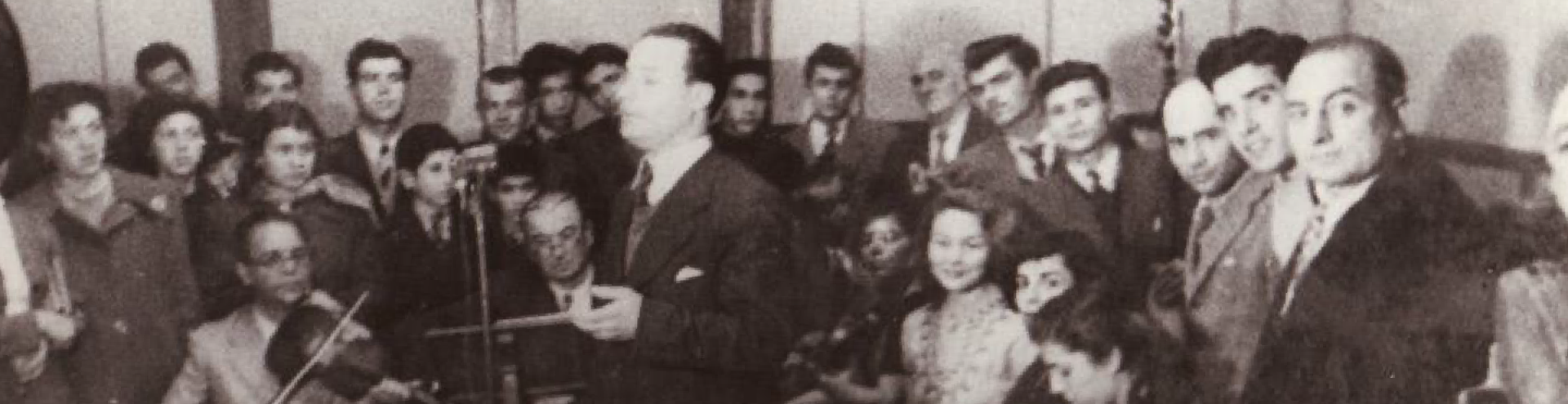
Voice and Instrumental Artists of Izmir Radio in Front of Izmir Radio
The Person with Glasses Standing in the Back Row and in the Middle is Rüştü Şardağ, the Registrar of Izmir Municipality, who was appointed as the Director of the Radio
Radio Week Magazine 1951

Mehmet Ali Hoşkan, “İzmir Radio Spikers”, Radyo Alemi Magazine
As the building of Izmir Radio operating in Kültürpark was insufficient, it was decided to move to the building of the Equestrian Sports Club on the right when you enter Kültürpark Dokuz Eylül Gate. Engineer Hilkat Bolulu, the founder of the radio, was summoned to Izmir and some renovations were made in the new building within the framework of his report. Izmir Radio, which stopped broadcasting for a short time due to the move, started to serve in its new building on August 20, 1951 with the opening speech of Muhlis Ete, Minister of Economy and Trade. Izmir Radio received many new technical features in its new building. The transmitter was placed in a small detached house, powered by underground cables and overhead wires and connected to the studio. In this way, the device was prevented from heating up, thus affecting both itself and the sounds. Secondly, two studio buildings were created at the radio station and the “artisans are saved from the trouble of tuning in the open, in the park”. These studios were managed by a technician from a separate room upstairs. In this way, the broadcasting of the necessary intermediate records, which were put in place to manage the entrance and exit, ended. Studio No. 1, reserved for large sessions, was covered with soft chelotex and the acoustics were arranged. Lights on a table in the director's office made it possible to monitor the emission situation in the studios.

In front: Zehra Hoşkan, Edip Erten, Tomris Yazıcı.
Back row from left: Kemal Mısırlı, Behiç Üsküdarlı, Mehmet Kasabalı, Kerim İleri and Fikret Karahan
Radio Alemi Magazine
In the early days, İzmir Radio broadcasted only on Saturdays and Sundays between 10:00 - 14:30 and 17:00 - 21:30. It was decided to broadcast Aegean music folklore, classical music, values raised by Izmir, historical beliefs, skits, Aegean mythology, geographical features, summaries from the Izmir press, children's hour, and to allocate a special section for Atatürk every week. In 1951, a permanent instrumental staff was established within Izmir Radio, and specialized committees for Eastern and Western music worked to bring new artists to the radio.
İzmir Radio was transferred to the General Directorate of Press and Broadcasting by the municipality on March 1, 1952. In 1953, the following statements were made in the magazine Radyo Âlemi about İzmir Radio, which was transformed into a state radio with the regulation made in 1953;
“Today, the country has embraced Izmir Radio, our third state radio station, with the same deep affection and appreciation as our other radios. Although this station cannot be heard in all parts of our country at the moment due to its voltage level, it is an obvious fact that it is followed with great interest in the places where it can be heard”.
In 1953, in order to provide better quality service in folk music, the radio administration appointed Mustafa Hoşsu as the conductor of the folk music department on the recommendation of Muzaffer Sarısözen. In a short period of time, Mustafa Hoşsu won the appreciation of the listeners and directed the Yurt Türküleri Choir. In 1955, when Muzaffer Sarısözen and Halil Bedii Yönetken came to Izmir, they listened to the choir run by Mustafa Hoşsu and deemed it appropriate to change the name of this choir, which had been publishing under the name Yurttan Türküler (Folk Songs of the Homeland), and requested the choir to work under the name Yurttan Sesler from now on.“Voices from Home”, named after him.
Izmir Radio worked with very limited means to develop its programs. In order to train local staff, an academic study system was established within the institution. In the mornings, music teachers such as Edip Erten, Mehmet Kasabalı, Fikret Karahan and Ali Duyarlar gave solfege, notation and method lessons, and in the afternoon, rehearsals for the next day were held until 14.00. İzmir Radio, which had two jazz orchestras, the Niyazi Erten Quartet and the Şefik Uyguner Trio, concentrated on Western music programs. The radio featured artists such as Güzin Ergün, Müjgan Akçeli, Mürvet Güdücü, Güzide Çelebi, Fikret Karahan, Kemal Mısırlı, Alaettin Şensoy, Adem Özesmer, Emin Gündüz and İsmet Tarhun. In 1955, a symphony orchestra was established within Izmir Radio, and the ’Amateur Hour” and amateur vocal and instrumental artists were trained.
Cüneyd Orhon made great contributions to the establishment of Izmir Radio. Serving between May 1, 1953 and July 1954, Cüneyd Orhon gives the following information about İzmir Radio;
“Let me tell you about the radio station I found when I went to Izmir. Our manager was Ümit Halit Demiriz, and it was his first time as a radio manager. It was one of the firsts in my life. I was the first chief of music broadcasts at İzmir radio. I also became the head of the music department in the following years.
There were wooden shack pavilions inside the Izmir Fair at that time. Ours was one of them, a two-story wooden pavilion building. Then it was needed, and instead of it, something small like an outbuilding was built, a shack like that. Then a room was added next to it, a plywood space. Cars pass by outside, the sound of the klaxon is inside. Children fly kites, their screams are inside. We were also close to the Basmane Train Station, around the gate, in the garden. A train passes by, train whistles can be heard, a place inside the train grunts”.
Launched in 1950 at the Izmir Fair, Izmir Radio won the love of the public in a short time. It has influenced the cultural and artistic life of both Izmir and Turkey with its quality programs and the artists it has trained, and has become one of the important symbols of the city in a short time. Izmir Radio, which was born in poverty and has grown stronger until today, has become one of the most important symbols of the city in a short period of time.“radio culture” is an important element of radio culture and this precious value needs to be passed on to younger generations. In our age where all kinds of artistic products are consumed within seconds, keeping radio culture alive and passing it on to future generations “only over voice” will allow them to look through the window of a created world, to understand and make sense of the past.